







How to Compare AI Search Tools Without Chasing Every New Launch
The digital information landscape is in constant flux, and few areas are evolving as rapidly as artificial intelligence. AI-powered search tools are emerging at an astonishing pace, each promising to revolutionize how we find, synthesize, and understand information. From conversational interfaces that answer complex questions directly to tools designed for academic research or creative brainstorming, the options seem endless. For anyone who relies on accurate, timely, and well-sourced information – whether you’re a student, researcher, content creator, or business professional – the sheer volume of new launches can be paralyzing. How do you discern genuine utility from fleeting novelty? How do you decide which AI search engine deserves a place in your essential toolkit without spending countless hours testing every new contender?
This guide offers a practical, evergreen framework for evaluating AI search tools. Instead of chasing every new announcement, we’ll focus on establishing a robust methodology for comparison. We’ll explore how to define your specific research needs, set up effective test cases, critically assess answer quality and citation integrity, and ultimately decide when and how an AI search tool can genuinely enhance your daily workflow. Our goal is to empower you to make informed decisions, ensuring that the AI tools you adopt truly serve your information-gathering objectives, rather than simply adding to the noise.
The Core Challenge: Information Overload, AI Edition
For decades, traditional search engines like Google have been our primary gateway to the internet’s vast repository of knowledge. They excel at indexing web pages and presenting a ranked list of links, leaving the synthesis and critical evaluation largely to the user. AI search tools, however, aim to go a step further. They often attempt to understand the intent behind your query, aggregate information from multiple sources, and present a concise, synthesized answer, sometimes even generating new content based on their findings. This shift from “links to answers” is profound, but it also introduces new complexities.
The primary challenge isn’t just the number of tools; it’s understanding their fundamental differences and limitations. Some AI search tools prioritize speed, others accuracy, some focus on specific domains, while others aim for general knowledge. They employ different underlying large language models (LLMs), access varying datasets, and have distinct approaches to citing sources. Without a systematic way to compare them, you risk falling into one of two traps: either dismissing AI search entirely due to a poor initial experience, or adopting a tool that doesn’t genuinely meet your needs, leading to frustration and potentially unreliable information. Our objective here is to cut through the marketing jargon and provide a clear path to evaluating these tools based on their practical utility and trustworthiness.
Defining Your Research Needs: The First Filter
Before you even open an AI search tool, the most crucial step is to understand your own information requirements. Just as you wouldn’t use a hammer to drive a screw, you shouldn’t expect every AI search tool to excel at every type of query. Clarifying your needs acts as the first, most effective filter, helping you narrow down the field of potential candidates.
What Kind of Information Do You Seek?
Consider the nature of your typical research questions. Are you:
- Seeking quick factual answers (e.g., “What is the capital of Mongolia?”)?
- Conducting in-depth academic research requiring peer-reviewed sources (e.g., “Analyze the impact of climate change on Arctic biodiversity”)?
- Looking for creative inspiration or brainstorming ideas (e.g., “Generate five unique plot twists for a sci-fi novel”)?
- Needing summaries of complex documents or articles (e.g., “Summarize the key findings of this 50-page research paper”)?
- Exploring current events and diverse perspectives (e.g., “What are the arguments for and against universal basic income?”)?
- Searching for practical how-to guides or troubleshooting steps (e.g., “How do I troubleshoot a common Wi-Fi connection issue?”)?
Each of these scenarios might benefit from a different AI search approach. Some tools are designed for broad, general knowledge, while others specialize in academic databases, news aggregation, or creative text generation.
What’s Your Tolerance for Novelty vs. Accuracy?
This is a critical distinction. For creative tasks, a tool that generates novel, even speculative, ideas might be highly valuable. For factual research, however, accuracy and verifiable citations are paramount. Understand where your work falls on this spectrum. If you’re writing a report that requires rigorous fact-checking, you’ll prioritize tools that emphasize source transparency and minimize “hallucinations” (AI-generated plausible but false information). If you’re brainstorming marketing slogans, a tool that offers creative variations might be more useful, even if some suggestions are off-the-wall. Your tolerance for error directly influences the features you should prioritize in an AI search tool.
Setting Up Your Test Cases: Real-World Scenarios
Once you’ve defined your needs, the next step is to create a set of specific, real-world test cases. These aren’t generic queries; they should be questions you genuinely need answers to, or representative of the types of questions you frequently encounter in your work. Using actual research questions ensures that your evaluation is grounded in practical utility rather than theoretical performance.
Aim for a diverse set of questions that challenge different aspects of an AI tool’s capabilities. Include:
- Factual Recall: Questions with clear, verifiable answers (e.g., “Who invented the World Wide Web and when?”).
- Complex Synthesis: Questions requiring information from multiple sources and logical deduction (e.g., “Compare and contrast the economic theories of John Maynard Keynes and Milton Friedman.”).
- Current Events/Timeliness: Questions about recent developments (e.g., “What were the major outcomes of the latest G7 summit?”).
- Domain-Specific: Questions related to your particular field of expertise (e.g., “Explain the concept of quantum entanglement in layman’s terms” if you’re a science writer).
- Problem-Solving/How-To: Questions seeking practical guidance (e.g., “What are the best practices for optimizing a WordPress website for SEO?”).
- Creative/Generative: Questions that invite more open-ended, creative responses (e.g., “Write a short poem about the feeling of discovery.”).
For each test case, you should ideally already know the answer, or at least have a strong idea of what a good answer would look like, based on your own research or expertise. This allows for objective comparison. Document your questions clearly, and be prepared to use the exact same phrasing across all AI tools you’re evaluating to ensure a fair comparison. Consistency in your input is key to isolating the performance differences between the tools.

The Evaluation Framework: Key Metrics for AI Search
With your test cases ready, it’s time to put the AI tools through their paces. As you interact with each tool, systematically evaluate its performance against a set of critical metrics. This structured approach helps move beyond subjective impressions to objective assessment.
Accuracy and Fact-Checking: The Non-Negotiable
This is arguably the most important metric. Does the AI tool provide correct information? AI models are known to “hallucinate” – generating confident but entirely false information. For any factual query, you must verify the answer.
- Cross-Reference: Check key facts against reliable, independent sources (e.g., reputable news organizations, academic journals, government websites).
- Look for Contradictions: Does the AI’s answer contradict widely accepted knowledge or other sources?
- Test for Nuance: Does the AI oversimplify complex topics or present a biased view?
- Identify Gaps: Does the answer omit crucial information that would be expected for the query?
Comprehensiveness and Depth
Does the answer provide sufficient detail for your needs? Some tools might offer a brief summary, while others delve into greater depth. A good tool should offer an appropriate level of detail given the query’s complexity and your stated needs. For complex questions, a comprehensive answer often includes context, background, and various perspectives.
Clarity and Coherence of Answers
Is the information presented in an easy-to-understand manner? Is the language clear, concise, and free of jargon (unless appropriate for the query)? A well-structured answer, often with headings, bullet points, or logical flow, significantly enhances usability. Avoid tools that produce rambling, repetitive, or poorly organized responses.
User Experience and Interface
While not directly related to answer quality, a clunky or unintuitive interface can significantly hinder your productivity. Consider:
- Ease of inputting queries.
- Clarity of results presentation.
- Ability to refine queries or ask follow-up questions.
- Speed of response.
- Overall aesthetic and navigability.
Citation Quality and Transparency
This is where many AI search tools differentiate themselves. Does the tool provide sources for its information? Are these sources credible and easily accessible?
- Direct Links: Does it link directly to the specific web pages or documents used?
- Source Diversity: Does it draw from a variety of reputable sources, or rely heavily on one or two?
- Contextual Citations: Are citations integrated naturally within the answer, indicating which parts of the answer come from which source?
- Date of Sources: Are the sources up-to-date, especially for time-sensitive topics?
A tool that offers transparent, high-quality citations empowers you to verify information and delve deeper, transforming it from a black box into a valuable research assistant.
Speed and Efficiency
How quickly does the tool generate responses? While accuracy is paramount, a tool that takes an excessively long time to respond might not be practical for your daily workflow, especially for quick lookups. Balance speed with the other quality metrics.

Hands-On Testing: A Step-by-Step Approach
Now, let’s put the framework into action. This systematic approach ensures you gather consistent data for comparison.
Step 1: Select a Diverse Set of Research Questions. As discussed, choose 5-10 questions that represent your typical information needs, ranging from simple facts to complex analyses and current events. Ensure you have a baseline understanding of the correct answers or expected content for each.
Step 2: Use Each AI Tool for the Same Questions. Open each AI search tool you’re evaluating. For each tool, input your first test question. Record the exact query you used. Then, copy the AI’s full response. Repeat this process for all your test questions and for every AI tool you’re comparing. Maintain consistency in your queries – minor rephrasing can sometimes lead to different results.
Step 3: Document Results Systematically. Create a simple spreadsheet or document to record your findings. For each tool and each question, note down:
- The exact query.
- The AI’s full response.
- A rating (e.g., 1-5) for accuracy, comprehensiveness, clarity, and citation quality.
- Specific observations (e.g., “hallucinated a date,” “provided excellent summary,” “citations were broken”).
- Any notable UX issues or advantages.
This systematic documentation is crucial for an objective comparison. It allows you to see patterns and identify strengths and weaknesses across different tools.
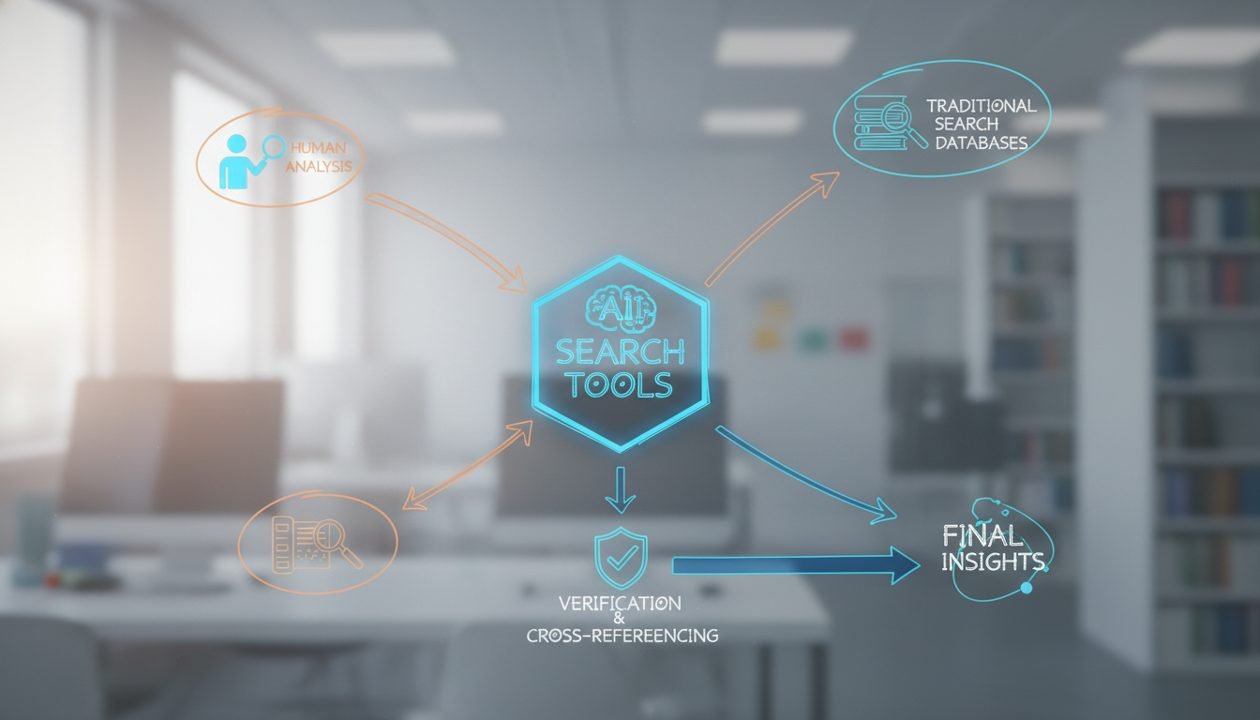
Step 4: Cross-Reference with Traditional Search/Human Expertise. Do not solely rely on the AI’s answer. For critical information, always cross-reference the AI’s output with traditional search engines, reputable databases, or your own expert knowledge. This step is vital for verifying accuracy and ensuring the AI hasn’t missed crucial context or presented a biased viewpoint. Think of the AI as a powerful assistant, not an infallible oracle.
Beyond the Hype: Practical Considerations for Integration
After your rigorous testing, you’ll likely have a clearer picture of which AI search tools perform best for your specific needs. The final step is to consider how these tools fit into your existing workflow.
When AI Search Excels (and When it Doesn’t)
AI search tools are not a panacea. They generally excel at:
- Summarization: Quickly distilling long articles or documents.
- Idea Generation: Brainstorming, generating creative text, or exploring different angles on a topic.
- Quick Factual Lookups: For well-established facts where hallucinations are less likely.
- Exploratory Research: Getting a quick overview of an unfamiliar topic to guide further, deeper research.
However, they often fall short when:
- Absolute Accuracy is Critical: Especially for highly specialized, nuanced, or rapidly evolving fields where real-time, verified data is essential.
- Deep Critical Analysis: AI can synthesize, but human critical thinking, interpretation, and judgment remain indispensable.
- Very Recent Events: While improving, AI models can sometimes lag behind the absolute latest news or data.
- Highly Subjective or Ethical Questions: AI lacks true understanding or moral compass.
Integrating AI into Your Workflow
Deciding when and how to use an AI search tool is key to maximizing its value.
- As a Starting Point: Use it to get an initial overview or to generate keywords for traditional search.
- For Brainstorming: Leverage its generative capabilities for creative tasks or to overcome writer’s block.
- For Summarization: Save time by having it condense lengthy reports or articles, but always verify key points.
- For Learning New Concepts: Ask it to explain complex ideas in simpler terms, then follow up with deeper, verified sources.
- Complement, Don’t Replace: View AI search as a powerful complement to your existing research methods, not a replacement for human intellect and critical verification.
By understanding its strengths and weaknesses, you can strategically deploy AI search to enhance your productivity and research quality without compromising accuracy.