






In today’s fast-paced digital world, information spreads at an unprecedented rate. While this connectivity offers incredible benefits, it also presents a significant challenge: distinguishing fact from fiction. With the rise of sophisticated AI tools capable of generating highly convincing text, images, and even video, the need for robust source verification has never been more critical. Whether you’re a content creator, a researcher, a journalist, or simply an informed citizen, developing a reliable workflow to verify claims is essential.
This guide will walk you through building a practical source verification workflow that integrates the power of AI as an assistant, leverages a suite of useful websites and tools, and crucially, emphasizes the irreplaceable role of human critical thinking and manual review. Our goal is to equip you with the strategies to confidently assess information before it influences your decisions or reaches your audience.
The Evolving Landscape of Information and the AI Factor
The internet has democratized information, but it has also created a fertile ground for misinformation, disinformation, and outright falsehoods. Social media algorithms often prioritize engagement over accuracy, leading to echo chambers and the rapid spread of unverified claims. The sheer volume of content makes it difficult to keep up, let alone scrutinize every piece of information.
The advent of advanced artificial intelligence, particularly large language models (LLMs) and generative AI, has added another layer of complexity. AI can produce coherent, grammatically correct, and contextually relevant text on almost any topic. While incredibly useful for content generation, summarization, and brainstorming, AI models are not inherently truth-tellers. They can hallucinate facts, perpetuate biases present in their training data, and confidently present incorrect information as truth. This means that content generated or even assisted by AI requires an even higher level of scrutiny.
Our verification workflow must acknowledge this new reality, using AI as a powerful assistant for initial analysis and organization, but never as the ultimate arbiter of truth. The human element of critical thinking, cross-referencing, and deep investigation remains paramount.
Core Principles of Effective Source Verification
Before diving into tools and steps, it’s crucial to understand the foundational principles that underpin effective source verification. These principles guide your approach and help you maintain a skeptical yet open mind.
- Lateral Reading: Instead of deep-diving into a single source immediately, open multiple tabs and research the source itself. Who runs the website? What is their reputation? What do other reputable sources say about the claim? This is a cornerstone technique for fact-checkers.
- Triangulation: Seek out at least three independent, credible sources that corroborate the same information. If only one source makes a significant claim, treat it with extreme caution.
- Check for Bias: Every source has a perspective. Understand the potential biases of the author, publication, or organization. Is it an advocacy group, a political think tank, a scientific journal, or a satirical news site?
- Consider the Evidence: Does the source provide evidence for its claims? Are there links to studies, data, or primary documents? Are these links valid and do they support the claim?
- Date and Context: Information can become outdated quickly. Check the publication date. Is the information still relevant? Has the context changed since it was published?
- Original Source: Always try to trace information back to its original source. A news report might cite a study; go find the study itself.
Leveraging AI as a First-Pass Assistant
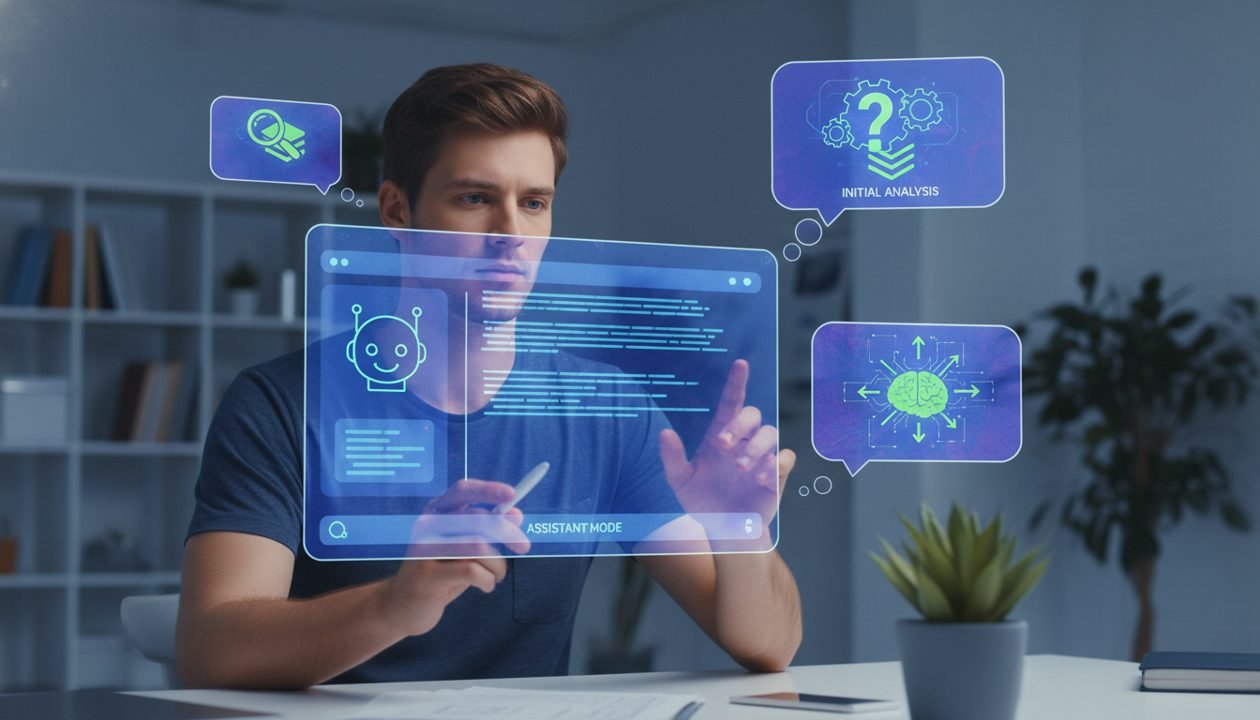
AI can be a remarkably efficient assistant in the initial stages of your verification workflow, helping you to quickly process information and identify potential avenues for deeper investigation. However, it’s vital to remember its limitations.
How AI Can Help:
- Summarization: Paste a long article or document into an AI assistant and ask for a concise summary. This helps you quickly grasp the main points and identify key claims that need verification.
- Keyword Extraction: Ask the AI to extract key entities, names, dates, and organizations mentioned in a text. These keywords become your starting points for lateral reading and searching.
- Initial Source Identification (with caution): You can ask AI, “What are some reputable sources discussing [topic]?” or “Who are the key experts in [field]?” While AI might provide a list, you must independently verify the credibility of these suggested sources and experts.
- Language Simplification: If a text is overly complex or uses jargon, AI can help simplify it, making it easier to understand the core claims.
AI’s Limitations and Ethical Use:
Never rely on AI for definitive answers to factual questions. AI models are trained on vast datasets and can confidently generate plausible-sounding but entirely false information (hallucinations). They do not ‘understand’ truth in the human sense. Always treat AI-generated information as a starting point for your own research, not as a verified fact.
When using AI, be mindful of data privacy. Avoid inputting sensitive or proprietary information into public AI models. Always disclose if AI was used in the creation or analysis of content you produce.
Essential Verification Tools and Websites
Once AI has helped you get your bearings, a suite of specialized online tools becomes indispensable for digging deeper. These resources allow you to perform lateral reading, check facts, and trace information to its origins.
Fact-Checking Sites:
These organizations are dedicated to verifying claims and debunking misinformation. They are excellent first stops for checking widely circulated claims.
- Snopes: One of the oldest and most well-known fact-checking sites, covering urban legends, internet rumors, and political claims.
- PolitiFact: Focuses on U.S. political claims, using its ‘Truth-O-Meter’ rating system.
- FactCheck.org: A non-partisan consumer advocate for voters that aims to reduce the level of deception and confusion in U.S. politics.
- International Fact-Checking Network (IFCN): A global hub that lists certified fact-checking organizations worldwide.
Reverse Image Search:
Images and videos can be easily manipulated or taken out of context. Reverse image search helps you find the original source and context of a visual.
- Google Images: Right-click an image (or drag and drop) to search for its origin.
- TinEye: Specializes in finding where an image has appeared online, even if it’s been cropped or altered.
- Yandex Images: Often effective for finding images from non-Western sources or for identifying faces.
Archive Tools:
Web pages can change or disappear. Archive tools preserve snapshots of websites over time, allowing you to see what a page looked like at a specific date.
- Wayback Machine (archive.org): The most comprehensive web archive, allowing you to view historical versions of millions of web pages.
- Archive.today (archive.ph): Another useful tool for creating and viewing snapshots of web pages.
Citation and Plagiarism Checkers:
While primarily used for academic integrity, these tools can help you identify if text has been copied from elsewhere, potentially indicating a lack of original research or proper attribution.
- Grammarly (Premium): Offers a plagiarism checker.
- Turnitin: Widely used in educational institutions to check for plagiarism.
- Quetext: A dedicated plagiarism checker.
Domain and WHOIS Lookups:
Understanding who owns a website can reveal potential biases or credibility issues.
- ICANN Lookup: Provides information about domain registration, including the registrant’s contact information (though often anonymized for privacy).
- DomainTools: Offers more in-depth historical WHOIS data and domain reputation analysis.
Statistical Data and Research Repositories:
For claims involving statistics or scientific research, go directly to the source.
- Google Scholar: Search for academic papers, theses, books, abstracts, and articles.
- PubMed: A free resource supporting the search and retrieval of biomedical and life sciences literature.
- World Bank Open Data: Access to global development data.
- National Statistical Offices: Most countries have official government bodies that publish reliable statistics (e.g., U.S. Census Bureau, Eurostat).
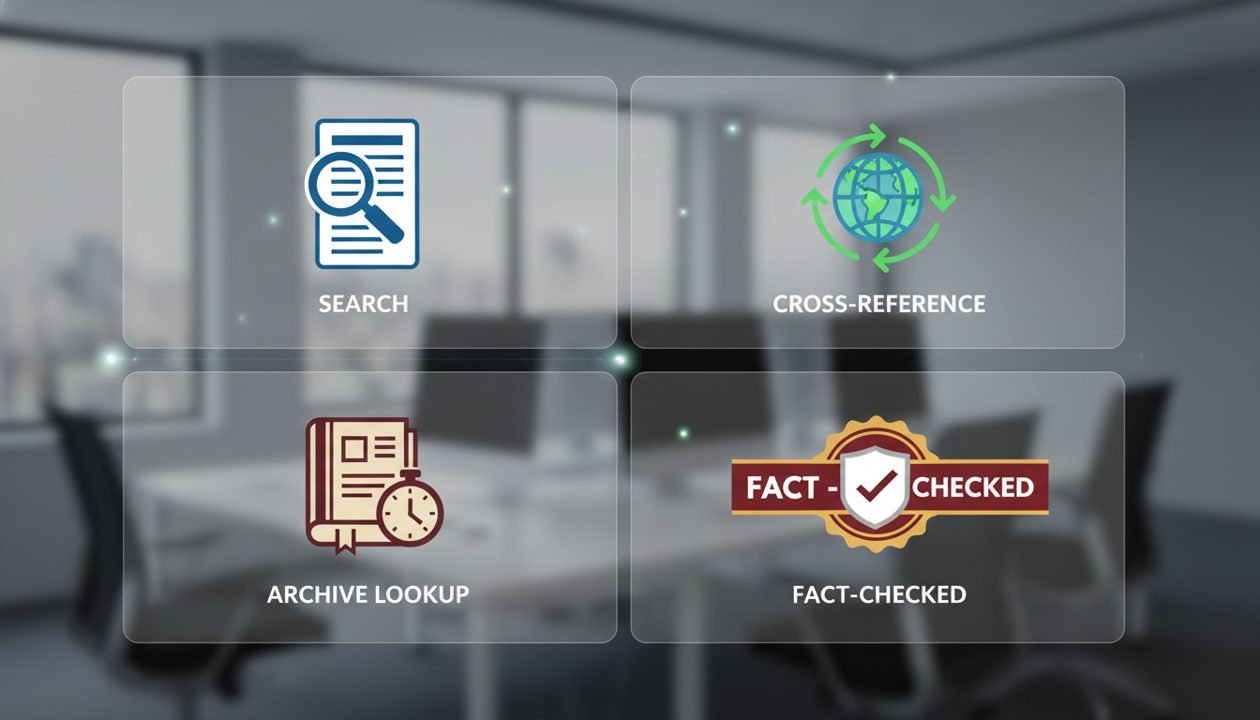
Building Your Step-by-Step Verification Workflow
Now, let’s integrate these tools and principles into a coherent, repeatable workflow. This checklist provides a structured approach to verifying information.
Initial Assessment & AI-Assisted Scan:
- Read the claim: What exactly is being stated? Identify key facts, figures, names, and dates.
- Consider the source (first glance): Who published it? What’s the URL? Does it look legitimate? (Don’t spend too long here; lateral reading comes next.)
- Use AI for summarization/keywords: If the text is long, ask an AI assistant to summarize it and extract key entities. This helps you quickly identify what needs verification.
- Identify potential red flags: Does the headline seem sensational? Is the language overly emotional? Are there obvious grammatical errors?
Lateral Reading & Source Vetting:
- Open new tabs: Don’t stay on the original page.
- Research the source: Search for the publication/website name + “bias,” “reputation,” “reviews,” or “fact-check.” What do independent sources say about its credibility?
- Research the author: Is the author an expert in the field? Do they have a known agenda?
- Check for funding/ownership: Who funds the organization? Are there any conflicts of interest? Use tools like Media Bias/Fact Check or Wikipedia for initial insights.
Triangulation & Evidence Review:
- Search for the core claim: Use your extracted keywords to search on Google, Google Scholar, or reputable news aggregators. Look for at least two other independent, credible sources that confirm or refute the claim.
- Examine the evidence: If the source cites studies, data, or experts, follow those links. Are the studies peer-reviewed? Is the data presented accurately?
- Reverse image/video search: If visuals are central to the claim, use Google Images, TinEye, or Yandex to find their original context. Has the image been used deceptively before?
- Check for original source: Can you trace the information back to a primary document, official statement, or original research?
Deep Dive with Specialized Tools:
- Fact-checking sites: Check Snopes, PolitiFact, FactCheck.org for specific claims, especially if they are widely circulated.
- Archive tools: If a web page seems to have changed or disappeared, use the Wayback Machine to see its historical versions.
- WHOIS lookup: For suspicious websites, use ICANN Lookup to investigate domain registration details.
- Statistical data: For numerical claims, consult official government statistical agencies or reputable research institutions.
Manual Review & Critical Analysis:
- Synthesize findings: Bring together all the information you’ve gathered. Do the pieces fit? Are there inconsistencies?
- Assess the totality of evidence: Does the weight of evidence support the original claim, refute it, or is it inconclusive?
- Identify remaining questions: What information is still missing? What aspects remain unclear?
- Consider the implications: What are the potential consequences of believing or sharing this information?
Practical Scenarios and Examples
Let’s consider a few brief examples of how this workflow might be applied:
- Scenario 1: A social media post claims a new ‘miracle cure’ for a common illness.
Workflow: Initial AI scan for keywords (illness, cure, ingredients). Lateral read on the source (often a blog or obscure website). Search for the ‘cure’ on PubMed or Google Scholar – are there peer-reviewed studies? Check fact-checking sites for similar health claims. Likely outcome: Debunked or highly suspicious. - Scenario 2: A news article reports a significant economic statistic.
Workflow: AI for keywords (country, economic indicator, year). Lateral read on the news outlet (reputation, bias). Search for the statistic on the country’s official national statistics website (e.g., Bureau of Labor Statistics, Eurostat) or the World Bank. Triangulate with other reputable financial news outlets. Likely outcome: Verified or clarified with context. - Scenario 3: An image circulates showing a dramatic event, supposedly recent.
Workflow: AI for context clues (location, event type). Reverse image search using Google Images/TinEye. This will often reveal if the image is old, from a different location, or digitally altered. Check reputable news sources for reports of the actual event. Likely outcome: Misleading or out of context.
Best Practices for Ongoing Verification
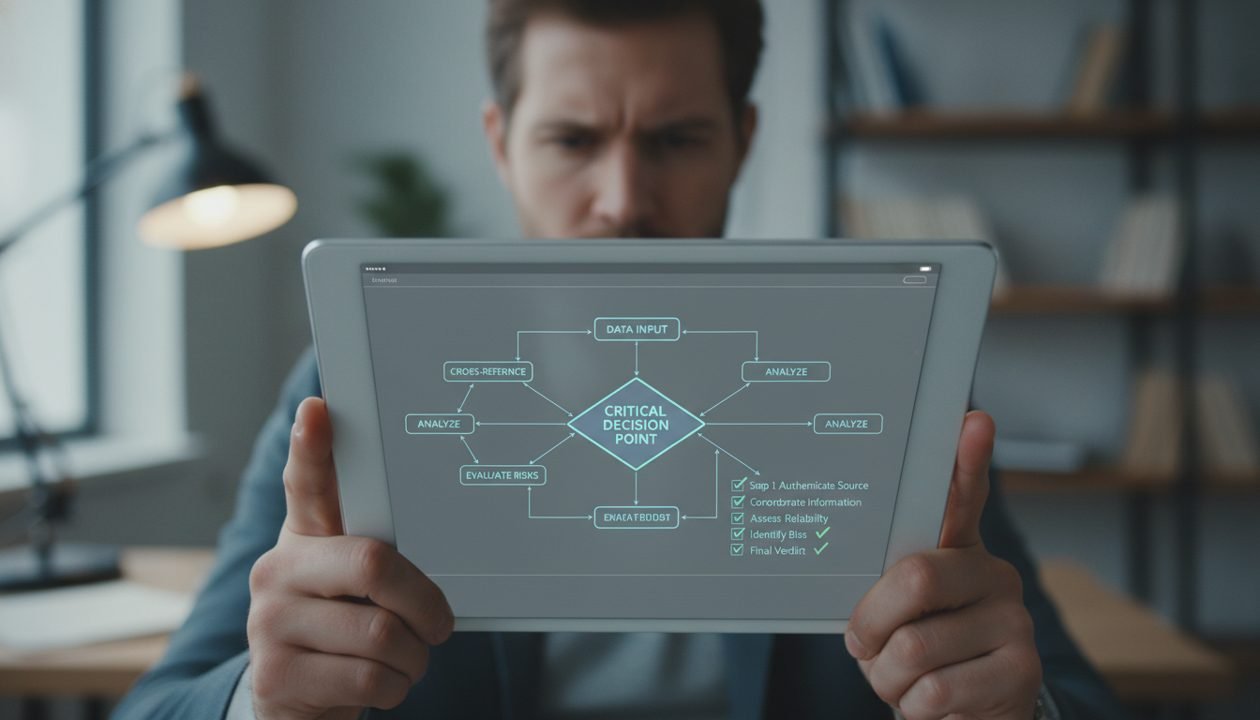
Building a robust verification workflow isn’t a one-time setup; it’s an ongoing commitment to informed decision-making. Here are some best practices to maintain and improve your skills:
- Cultivate a Healthy Skepticism: Approach all information, especially sensational or emotionally charged content, with a critical eye.
- Stay Updated: The landscape of misinformation and verification tools is constantly evolving. Follow reputable fact-checkers and media literacy experts.
- Vary Your Information Diet: Don’t rely on a single source or type of media. Expose yourself to diverse perspectives and news outlets.
- Document Your Findings: For important claims, keep notes on what you checked, what you found, and why you reached your conclusion. This can be invaluable for future reference or if you need to explain your reasoning.
- Practice Regularly: The more you apply this workflow, the faster and more intuitive it will become. Make it a habit to verify before you share or act.
- Understand Your Own Biases: Be aware of confirmation bias (the tendency to seek out information that confirms your existing beliefs) and actively work to counteract it.
- Be Patient: Thorough verification takes time. Resist the urge to quickly share or react to unverified information.
Conclusion
In an era where information overload and sophisticated misinformation tactics are the norm, developing a systematic approach to source verification is no longer optional – it’s a fundamental skill. By integrating AI as an intelligent assistant for initial processing, leveraging a diverse toolkit of online resources, and steadfastly applying critical thinking and manual review, you can build a powerful workflow that empowers you to navigate the digital landscape with confidence.
Remember, AI is a tool, not a truth machine. The ultimate responsibility for verification rests with you. Embrace the principles of lateral reading, triangulation, and healthy skepticism, and you’ll be well-equipped to make informed decisions and contribute to a more accurate information ecosystem.