








Introduction: Navigating the AI Feature Deluge
The world of Artificial Intelligence is evolving at an astonishing pace. Every week, it seems, a new AI model emerges, an existing one gains groundbreaking capabilities, or a familiar tool integrates a suite of powerful AI features. For curious readers eager to harness this technology, the sheer volume of information can be overwhelming. How do you keep up? More importantly, how do you move beyond simply knowing about a new feature to truly understanding and effectively utilizing it?
Traditional learning methods, like passively reading release notes or watching quick demo videos, often fall short. They might give you a glimpse, but they rarely equip you with the practical knowledge needed to integrate these features into your workflow or solve real-world problems. The smarter way to learn new AI features isn’t about consuming more content; it’s about strategic engagement, focused experimentation, and iterative refinement.
This guide is designed to cut through the noise. We’ll provide a structured, actionable framework that empowers you to approach AI learning with purpose. You’ll discover how to identify what truly matters, experiment effectively, understand the nuances of AI interaction, and ultimately, transform new features from intriguing novelties into indispensable tools in your personal and professional arsenal. Prepare to shift from a reactive consumer of AI news to a proactive master of its capabilities.
The “Why” Before the “How”: Defining Your Learning Objective
Before you dive headfirst into the latest AI update, pause and ask yourself: Why am I learning this? This fundamental question is the cornerstone of effective AI feature acquisition. Without a clear objective, you risk falling into the trap of feature-hopping – superficially exploring countless tools without gaining proficiency in any. This leads to wasted time, frustration, and a feeling of being perpetually behind.
A smarter approach begins with identifying a specific problem you want to solve, a task you want to optimize, or a creative goal you aim to achieve. AI features are solutions, but they only become valuable when applied to a defined challenge. Consider these example scenarios:
- Content Creation: Perhaps you struggle with writer’s block for blog post outlines, or you need to quickly generate diverse headlines for A/B testing. Your objective might be: “Learn how to use an AI writing assistant to generate five unique blog post outlines in under 10 minutes.”
- Data Analysis: You might be spending too much time summarizing lengthy reports or extracting key insights from unstructured text. Your objective could be: “Master an AI summarization tool to distill a 50-page report into a one-page executive summary with key takeaways.”
- Coding Assistance: Developers might want to accelerate boilerplate code generation or debug complex functions. An objective here could be: “Utilize an AI coding assistant to generate a functional Python script for data parsing, reducing manual coding time by 30%.”
By formulating a clear, measurable objective, you create a filter. This filter helps you ignore irrelevant features and focus your energy on those that directly contribute to your goal. It transforms abstract learning into a practical quest with a tangible outcome. Your objective will guide your exploration, inform your experiments, and provide a benchmark for success.
Targeted Exploration: Beyond the Hype Reel
Once your learning objective is clear, the next step is to engage in targeted exploration. The internet is awash with information about AI, but not all sources are created equal. To learn smarter, you need to distinguish between marketing hype and practical utility.
Start by seeking out official documentation. AI developers often provide comprehensive guides, API references, and tutorials that explain features in detail, including their intended use cases and limitations. These are invaluable resources for understanding the core mechanics. Beyond official sources, look for reputable technology blogs, academic papers (if applicable to your objective), and specialized online communities where experienced users share practical insights and troubleshooting tips.
Avoid the temptation to chase every viral demonstration. Instead, focus on understanding the fundamental capabilities of the AI feature relevant to your objective. For instance, if your goal is text summarization, you’d prioritize learning about prompt structure, output length controls, and contextual understanding, rather than getting sidetracked by image generation capabilities of the same model.
Here are some reliable sources for targeted AI feature information:
- Official Documentation: Always the first stop. Look for developer guides, API references, and release notes directly from the AI model or tool provider.
- Reputable Tech Blogs and Journals: Publications known for in-depth analysis and practical tutorials, not just news aggregation.
- Specialized Forums and Communities: Platforms like Reddit (e.g., r/singularity, r/ChatGPT), Discord servers dedicated to specific AI tools, or professional networks where users share real-world experiences.
- Academic Papers (for advanced users): If you’re interested in the underlying mechanisms or cutting-edge research, platforms like arXiv can be useful.
- Curated Newsletters: Subscribe to newsletters that provide summaries of key AI developments and practical applications, rather than just breaking news.
By being selective and critical about your information sources, you ensure that your learning is efficient and focused on actionable knowledge. This targeted approach prevents information overload and builds a solid foundation for practical application.

The Sandbox Approach: Hands-On Experimentation
Reading about an AI feature is one thing; actually using it is another entirely. The most effective way to learn is through direct, hands-on experimentation. Think of it as setting up a sandbox – a safe, controlled environment where you can play, break things, and discover without fear of real-world consequences.
Many AI tools offer free tiers, trial periods, or developer playgrounds specifically for this purpose. Utilize these to their fullest. Your goal in the sandbox is not immediate perfection, but rather iterative discovery. Start with small, controlled experiments directly related to your learning objective. Don’t try to build a complex system right away. Instead, isolate variables and test one aspect of the feature at a time.
For example, if your objective is to generate blog post outlines, begin by testing different prompt structures for a single topic. Observe the outputs, identify what works and what doesn’t, and then adjust your inputs for the next iteration. This iterative testing cycle – hypothesize, experiment, observe, refine – is crucial for building intuitive understanding.
Here’s a checklist for effective sandbox testing:
- Define a Micro-Experiment: Break down your objective into the smallest possible testable units. (e.g., “Test how varying the tone in a prompt affects the output of a short story.”)
- Set Up a Controlled Environment: Use a dedicated project, a free tier, or a specific notebook/document to keep your experiments organized and isolated.
- Document Your Inputs: Always record the exact prompts, parameters, and settings you use for each experiment. This is vital for reproducibility and learning.
- Analyze Outputs Critically: Don’t just accept the AI’s output. Evaluate it against your expectations and objective. What was good? What was bad? Why?
- Iterate and Refine: Based on your analysis, adjust your inputs (prompts, parameters) and run the experiment again. This is where true learning happens.
- Identify Patterns: Look for recurring themes or behaviors in the AI’s responses. This helps you build a mental model of how the feature operates.
- Push Boundaries: Once you have a basic understanding, intentionally try to make the AI fail or produce unexpected results. This reveals its limitations and edge cases.
The sandbox approach transforms passive learning into active engagement, allowing you to build practical skills and a deep understanding of the AI feature’s capabilities and constraints.
Deconstructing Prompts and Parameters: The Language of AI
At the heart of interacting with most modern AI features, especially large language models, lies prompt engineering and parameter tuning. Understanding these two elements is akin to learning the language of AI. It’s how you communicate your intentions and guide the AI to produce the desired output.
Prompt Engineering: A prompt is your instruction to the AI. It’s not just a question; it’s a carefully crafted directive that provides context, constraints, and examples. A well-engineered prompt can unlock vastly superior results compared to a vague one. Key aspects include:
- Clarity and Specificity: Be explicit about what you want. Avoid ambiguity. Instead of “Write about dogs,” try “Write a 200-word persuasive paragraph about why golden retrievers make excellent family pets, focusing on their temperament and trainability.”
- Context: Provide background information the AI needs to understand your request fully. This might involve previous turns in a conversation or relevant data points.
- Constraints: Specify length, format (e.g., “in bullet points,” “as a JSON object”), tone (e.g., “professional,” “humorous”), and style.
- Examples (Few-Shot Learning): For complex tasks, providing one or more examples of desired input-output pairs can significantly improve the AI’s performance. This teaches the AI the pattern you’re looking for.
- System Prompts vs. User Prompts: Some AI interfaces allow for a “system prompt” which sets the overall persona or instructions for the AI, guiding all subsequent user prompts. Understanding how to leverage this can be powerful.
Parameters: Beyond the prompt, many AI models offer adjustable parameters that influence the generation process. These are like the dials and sliders on a sophisticated machine. Common parameters include:
- Temperature: Controls the randomness of the output. Higher temperatures lead to more creative, diverse, and sometimes less coherent results. Lower temperatures make the output more deterministic and focused.
- Top_P (Nucleus Sampling): Another way to control randomness, focusing on a subset of tokens with a cumulative probability.
- Max_Tokens: Sets the maximum length of the generated output.
- Frequency Penalty & Presence Penalty: These parameters can discourage the AI from repeating words or phrases too often, promoting more diverse language.
Practical Prompting Tips
Experimenting with prompts and parameters is an art and a science. Start by varying one element at a time to observe its impact. Keep a log of your prompts and the resulting outputs. This systematic approach will help you build an intuitive understanding of how to “speak” to the AI effectively.
Remember, the AI doesn’t understand your intent; it understands patterns in data. Your job as a prompt engineer is to provide the clearest possible pattern for it to follow.

Iteration and Refinement: The Path to Mastery
Learning an AI feature is rarely a one-shot deal. It’s an ongoing process of iteration and refinement. The first output you get from an AI might be good, but it’s rarely perfect. The smarter way to learn involves critically analyzing outputs, understanding why the AI responded the way it did, and then adjusting your inputs to guide it closer to your desired outcome.
This iterative loop is where true mastery is forged. It’s about developing a keen eye for what’s missing, what’s extraneous, and what could be improved. Don’t be afraid to go back to the drawing board with your prompts or adjust your parameters. Each refinement teaches you more about the AI’s capabilities and limitations.
Documenting your findings is a crucial part of this process. Keep a simple log or a dedicated document where you note:
- The exact prompt and parameters used.
- The AI’s output.
- Your evaluation of the output (e.g., “Good, but too verbose,” “Missed the key point,” “Perfect tone”).
- The changes you made for the next iteration.
This documentation serves as a personal knowledge base, allowing you to recall successful strategies and avoid repeating past mistakes. Over time, you’ll start to recognize patterns in how the AI responds to certain types of prompts or parameter settings, enabling you to anticipate its behavior and craft more effective instructions from the outset.
Here are key questions to ask yourself when evaluating AI outputs:
- Does it meet the objective? Is the output directly addressing the problem or goal you set out to achieve?
- Is it accurate and factual (if applicable)? Does the information provided align with known facts or your specific context?
- Is the tone and style appropriate? Does it match the desired voice and audience?
- Is the length and format correct? Did the AI adhere to any specified constraints on output size or structure?
- Is it coherent and logical? Does the output flow naturally and make sense?
- Are there any hallucinations or irrelevant details? Did the AI invent information or include unnecessary content?
- How could the prompt be improved? What specific changes to clarity, context, constraints, or examples would lead to a better result?
Embrace the iterative nature of AI interaction. Each refinement brings you closer to harnessing the feature’s full potential for your specific needs.
Integration and Real-World Application
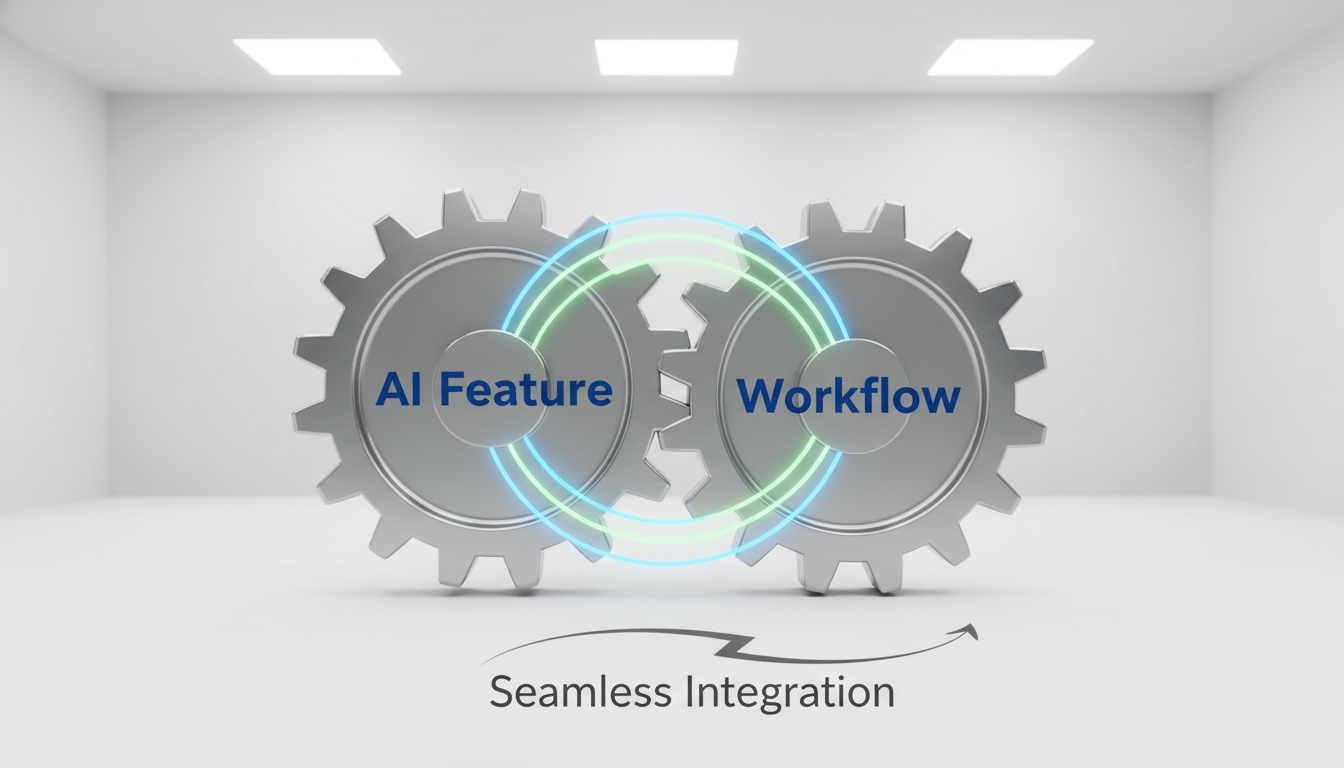
The ultimate goal of learning a new AI feature is to integrate it effectively into your real-world workflows. Moving from the sandbox to practical application requires a thoughtful approach. It’s not about replacing everything you do with AI, but rather identifying specific bottlenecks or areas where AI can augment your capabilities and improve efficiency.
Start small. Don’t try to overhaul an entire process at once. Identify a single, recurring task that consumes a disproportionate amount of time or effort and see if the AI feature you’ve learned can streamline it. For instance, if you’ve mastered an AI summarization tool, begin by using it to summarize internal meeting notes or research papers, rather than immediately deploying it for client-facing reports.
Monitor the performance and impact of the integrated AI feature. Is it truly saving you time? Is the quality of the output consistent? Are there new challenges or considerations that arise in a real-world context? Be prepared to adjust your workflow, your prompts, or even the AI tool itself based on these observations.
Case Study Example: AI for Blog Post Outlines
Let’s revisit our content creation objective: using an AI writing assistant to generate blog post outlines. After extensive sandbox testing, you’ve discovered that a prompt like “Generate a detailed 7-section blog post outline about ‘The Smarter Way to Learn New AI Features,’ including H2 and H3 headings, an introduction, and a conclusion. Focus on actionable advice for curious readers.” consistently yields excellent results.
Integration Steps:
- Identify the Workflow Gap: You typically spend 30-60 minutes brainstorming and structuring each blog post outline.
- Pilot Integration: For your next five blog posts, use the AI to generate the initial outline.
- Review and Refine: Compare the AI-generated outline with what you would have created. Edit, add, or remove sections as needed. Note how much time this review takes compared to creating from scratch.
- Measure Impact: Track the total time saved per outline. Evaluate the quality and creativity of the AI-generated outlines.
- Iterate Workflow: If successful, formalize this step: “Before writing, generate an AI outline, then spend 15 minutes refining it.”
This gradual integration allows you to validate the AI’s utility in a practical setting, build confidence, and smoothly transition from experimentation to efficient application.
Staying Current: Continuous Learning Strategies
The AI landscape is dynamic, and new features will continue to emerge. A smarter way to learn isn’t just about mastering a single feature; it’s about developing a sustainable strategy for continuous learning without being overwhelmed. The goal is to stay informed and adaptable, not to chase every fleeting trend.
Here are some strategies for staying current effectively:
- Curated Information Sources: Instead of broad news feeds, subscribe to highly curated newsletters or follow specific thought leaders who provide insightful analysis rather than just announcements. Look for sources that focus on practical applications and deeper dives into new features.
- Official Release Notes and Blogs: Regularly check the official blogs and release notes of the AI tools you actively use. These are the most reliable sources for understanding new capabilities and updates.
- Dedicated Learning Time: Schedule a small, consistent block of time each week (e.g., 30 minutes) specifically for AI learning. This could involve reviewing updates, trying out a new micro-experiment, or reading a relevant article. Consistency is key.
- Join Specific Communities: Participate in online forums, Discord servers, or professional groups focused on the AI tools you use. These communities are often the first to discuss new features, share tips, and troubleshoot issues.
- Build a Personal Knowledge Base: Maintain a system (e.g., Notion, Obsidian, a simple document) where you log your AI learning. This includes successful prompts, useful parameters, insights from experiments, and summaries of new features you’ve explored. This becomes your personalized, searchable AI reference.
- Focus on Core Concepts: While features change, underlying AI concepts (e.g., prompt engineering principles, model architectures, ethical considerations) evolve more slowly. A strong grasp of these fundamentals will make it easier to adapt to new features.
By adopting these continuous learning strategies, you can maintain a proactive stance in the face of rapid AI innovation, ensuring that your skills remain sharp and relevant without succumbing to information overload.
Conclusion: Empowering Your AI Journey
The rapid evolution of AI presents both incredible opportunities and significant challenges. For those eager to leverage its power, the traditional approach of passive consumption is no longer sufficient. The smarter way to learn new AI features is a deliberate, structured, and hands-on journey.
By starting with a clear objective, engaging in targeted exploration, embracing the sandbox for experimentation, mastering the language of prompts and parameters, committing to iteration and refinement, and thoughtfully integrating AI into your real-world tasks, you transform yourself from a casual observer into a proficient practitioner. This guide has provided you with a roadmap to navigate the AI landscape with confidence and purpose.
Remember, AI is a tool, and like any powerful tool, its effectiveness lies in the skill of its user. By adopting these strategies, you’re not just learning features; you’re cultivating a mindset of continuous improvement and strategic application that will empower your AI journey for years to come. The future is intelligent, and with a smarter approach to learning, you’ll be at the forefront of shaping it.