
The Best Emerging AI Workflows for Creators and Small Teams
The landscape of work for creators and small teams is undergoing a profound transformation, largely driven by the rapid evolution of Artificial Intelligence. What once seemed like futuristic concepts are now practical, accessible tools that can dramatically enhance efficiency, spark creativity, and streamline operations. Yet, with so many new AI tools emerging daily, understanding how to integrate them effectively into a cohesive workflow can feel daunting. This guide is designed to cut through the noise, offering clear, actionable insights into the best emerging AI workflows that are proving invaluable for creators and small teams right now.
We’ll explore practical applications, provide concrete examples, and offer takeaways you can implement immediately. This isn’t about chasing every shiny new AI gadget; it’s about discovering robust, repeatable processes that leverage AI to amplify your existing efforts, allowing you to focus more on strategic thinking and creative output rather than repetitive tasks. If you’re curious about how AI can genuinely make a difference in your day-to-day, let’s dive into these transformative workflows.
AI for Intelligent Content Ideation and Research
Before a single word is written or a pixel is placed, the journey of content creation begins with ideation and research. This initial phase, often time-consuming, is where AI can offer some of its most impactful contributions, helping creators and small teams to not only generate a wealth of ideas but also to rapidly synthesize complex information.
Brainstorming with Large Language Models (LLMs)
Gone are the days of staring at a blank page, waiting for inspiration to strike. Large Language Models (LLMs) like ChatGPT, Claude, or Google’s Gemini can act as an infinitely patient brainstorming partner. By providing a clear prompt, you can generate a diverse array of content ideas, angles, and formats in mere seconds. For instance, if you’re a small marketing agency, you could prompt an LLM with: “Generate 20 unique blog post titles about sustainable fashion for Gen Z, focusing on practical tips and ethical brands.” The results can kickstart your editorial calendar, offering perspectives you might not have considered initially.
Beyond titles, LLMs can help you:
- Develop comprehensive content outlines for articles, videos, or podcasts.
- Suggest compelling hooks and introductions for various topics.
- Explore different angles or niches within a broad subject area.
- Identify potential audience questions or pain points related to a topic.
The key here is iterative prompting: start broad, then refine your requests based on the initial output to narrow down to truly valuable ideas.
Rapid Research Synthesis
Once you have a topic, the next step is often extensive research. AI tools are becoming incredibly adept at sifting through vast amounts of information and summarizing key points. Instead of manually reading dozens of articles or reports, you can feed relevant documents, web links, or even entire PDFs into an AI tool (some LLMs have this capability built-in, or dedicated research AI tools can be used). These tools can then extract core arguments, identify common themes, and highlight crucial data points.
For example, a small design studio looking to understand emerging UI/UX trends could input several industry reports. The AI could then summarize the key trends, list influential designers, and even suggest visual styles, saving hours of manual review. This allows creators to quickly grasp the essence of a subject, identify gaps in their knowledge, and build a solid foundation for their content.
Streamlining Content Creation: From Draft to Polish
With ideas and research in hand, the actual creation process can begin. AI is no longer just a fancy spell-checker; it’s an active participant in drafting, refining, and repurposing content, significantly reducing the time and effort required to produce high-quality output.
First Draft Generation
One of the most powerful applications of AI for creators is generating first drafts. Whether it’s a blog post, social media captions, email newsletters, or even scripts for short videos, LLMs can produce coherent and contextually relevant text based on your outline and research notes. Instead of facing a blank page, you start with a substantial draft that you can then edit, infuse with your unique voice, and fact-check.
Consider a small business owner needing to write a product description. By providing details about the product’s features, benefits, and target audience, an AI can generate several variations, allowing the owner to pick the best one and fine-tune it. This drastically cuts down on the initial writing hurdle and helps maintain a consistent publishing schedule.
Enhancing and Refining Text
Beyond initial drafts, AI excels at refining existing content. Tools can analyze your text for readability, tone, grammar, and style, offering suggestions for improvement. This is particularly useful for ensuring clarity, conciseness, and engagement across all your communications.
You can use AI to:
- Rewrite sentences for better flow or impact.
- Adjust the tone to be more formal, casual, persuasive, or empathetic.
- Simplify complex jargon for a broader audience.
- Expand on brief notes into fully developed paragraphs.
- Check for grammatical errors and stylistic inconsistencies that traditional checkers might miss.
This phase is where your human touch becomes critical. AI provides the suggestions, but you make the final decisions, ensuring the content resonates with your brand voice and objectives.
Repurposing Across Platforms
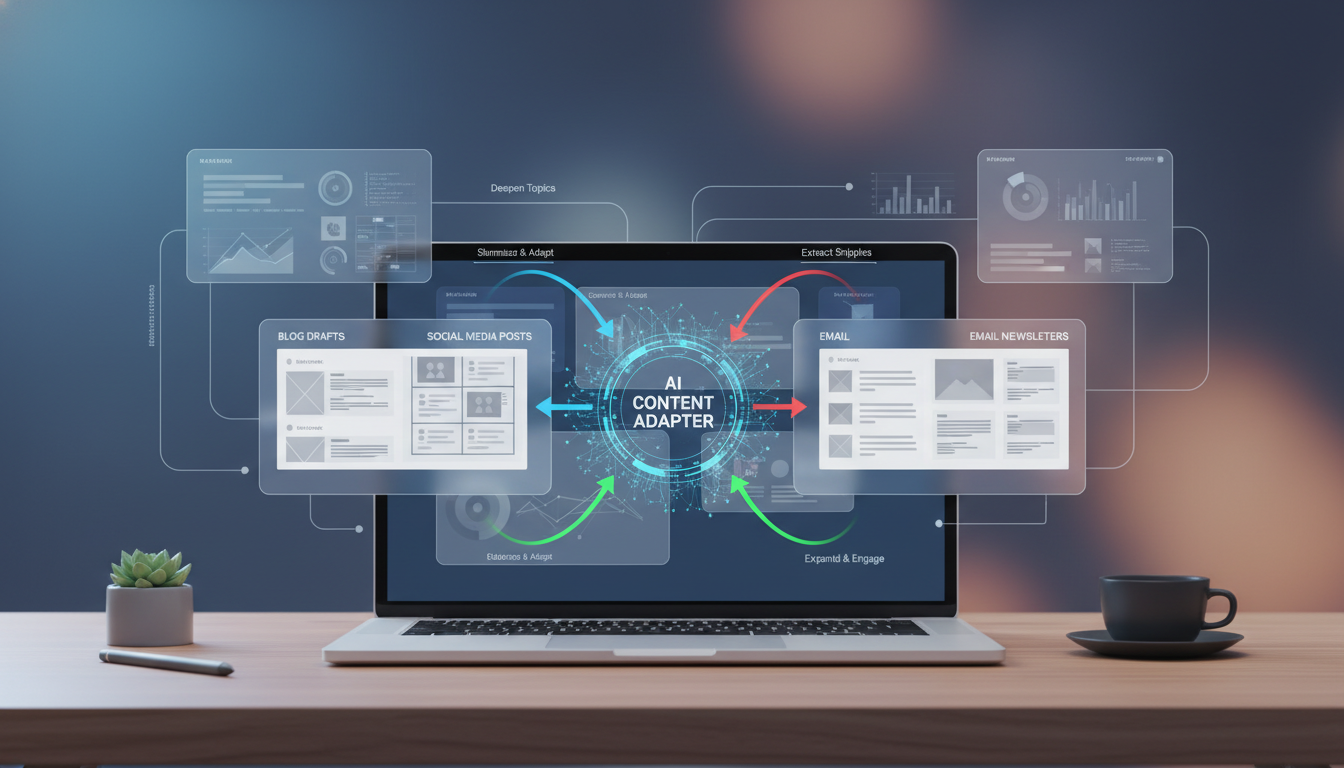
Creating content for multiple platforms (blog, social media, email, video scripts) can be incredibly time-consuming. AI streamlines this by efficiently repurposing your core content. A single blog post can be transformed into a series of tweets, an Instagram carousel script, a LinkedIn article, and an email newsletter with specific calls to action.
For example, after writing a detailed blog post, you could prompt an AI: “Summarize this blog post into 5 bullet points suitable for a LinkedIn update,” or “Write 10 different Instagram captions for this blog post, each with relevant hashtags.” This multiplies the reach and value of your original content without significant additional effort.
Visual Content Generation and Enhancement
In today’s visually driven world, compelling images and videos are non-negotiable. AI has revolutionized the creation and enhancement of visual assets, making high-quality visuals accessible even to creators without extensive design experience or large budgets.
AI-Powered Image Creation
Generative AI models like Midjourney, DALL-E, and Stable Diffusion allow creators to generate unique images from text prompts. This means you can create custom blog post headers, social media graphics, illustrations, or even product mockups without needing to search stock photo libraries or hire a graphic designer for every single asset.
A content creator could prompt: “An abstract digital illustration representing data flowing through a network, vibrant blue and purple tones, minimalist, 4K.” Within moments, several unique images are generated, ready for selection and minor editing. This capability is a game-changer for maintaining a distinct visual identity and producing fresh, relevant imagery consistently.
Video Scripting and Editing Assistance
While full video generation is still evolving, AI tools are already highly effective at assisting with video production. LLMs can help write compelling video scripts, generate ideas for B-roll footage, and even suggest cuts and transitions based on a written narrative. For small teams producing explainer videos or social media clips, this can significantly speed up the pre-production phase.
Furthermore, AI-powered editing tools can automate tedious tasks like transcription, subtitle generation, background noise reduction, and even identifying key moments in footage for highlight reels. This frees up video editors to focus on the creative storytelling aspects rather than the manual grind of post-production.
Optimizing Marketing and Distribution with AI
Creating great content is only half the battle; getting it in front of the right audience is just as crucial. AI offers powerful capabilities for optimizing your marketing efforts, from search engine visibility to engaging with your audience on social media and through email.
SEO Keyword and Content Optimization
AI can revolutionize your Search Engine Optimization (SEO) strategy. Tools can analyze search trends, identify high-value keywords, and even suggest content topics that have a strong chance of ranking. Beyond keyword research, AI can help optimize your existing content by suggesting improvements to titles, meta descriptions, internal linking, and even paragraph structure to better align with SEO best practices.
For a small e-commerce store, AI could analyze product descriptions and suggest keyword insertions or rewrites to improve their visibility in search results, driving more organic traffic without expensive advertising campaigns.
Social Media Content Scheduling and Analysis
Managing multiple social media channels can be a full-time job. AI tools can assist by generating diverse social media captions tailored to each platform’s nuances, suggesting optimal posting times based on audience engagement data, and even analyzing performance metrics to identify what content resonates most effectively.
Imagine an AI tool suggesting that your Instagram audience engages most with carousel posts on Tuesdays at 11 AM, and then generating five different caption options for your new product launch, complete with relevant emojis and hashtags. This level of insight and automation ensures your social media presence is consistently optimized and engaging.

Project Management and Collaboration with AI
Even the smallest teams can benefit immensely from AI’s ability to streamline project management and enhance internal collaboration. By automating routine tasks and providing intelligent summaries, AI frees up valuable time for strategic work.
AI for Task Automation
AI can take on many administrative burdens. For instance, integrated with your project management software, AI could automatically categorize incoming requests, assign simple tasks based on keywords, or even set up recurring tasks based on project milestones. This reduces the manual effort of project setup and ensures that no task falls through the cracks.
Consider a small agency managing client projects. An AI tool could monitor client communication, identify actionable items, and automatically create tasks in your project management system, notifying the relevant team member. This ensures responsiveness and keeps projects on track.
Intelligent Meeting Summaries
Meetings are essential, but the process of taking notes and distributing summaries can be tedious. AI-powered transcription and summarization tools can record meetings (with consent), transcribe them accurately, and then generate concise summaries, highlighting key decisions, action items, and responsible parties. This ensures everyone is on the same page without the need for manual note-taking, making meetings more productive and follow-ups more efficient.
Imagine ending a client call and having an AI-generated summary delivered to your inbox within minutes, detailing all agreed-upon next steps and deadlines. This not only saves time but also reduces miscommunication.

Personalization and Audience Engagement
Connecting with your audience on a personal level is key to building loyalty and driving conversions. AI offers powerful ways to understand your audience better and tailor your interactions, even for small teams with limited resources.
Tailored Content Recommendations
While complex recommendation engines might be beyond the scope of a small team, AI can still help personalize content delivery. By analyzing simple user behavior data (e.g., which blog posts they’ve read, products they’ve viewed), AI can suggest future content topics or product recommendations that are more likely to resonate. This can be implemented through email marketing segments or even simple pop-up suggestions on your website.
For a niche online course creator, an AI could identify students who completed a foundational course and then automatically suggest the next logical advanced course via email, increasing conversion rates and student satisfaction.
Chatbots for Customer Support
Providing 24/7 customer support can be challenging for small teams. AI-powered chatbots can handle a significant portion of routine customer inquiries, answering frequently asked questions, guiding users through processes, and even collecting information before escalating to a human agent. This frees up your team to focus on more complex issues, improving overall customer satisfaction and response times.
A small e-commerce site can deploy a chatbot to answer questions about shipping, returns, or product specifications, providing immediate assistance to customers and reducing the load on a small support team.
Ethical Considerations and Best Practices for AI Workflows
While the benefits of AI are clear, responsible implementation is paramount. Creators and small teams must approach AI with an understanding of its limitations and ethical implications. Integrating these tools effectively means adopting best practices that ensure accuracy, fairness, and transparency.
A Checklist for Responsible AI Use:
- Maintain Human Oversight: Always review AI-generated content and decisions. AI is a tool, not a replacement for human judgment and creativity.
- Fact-Check Rigorously: AI models can sometimes ‘hallucinate’ or present incorrect information as fact. Always verify any critical data or claims generated by AI.
- Be Aware of Bias: AI models are trained on vast datasets, which can sometimes contain inherent biases. Be mindful of potential biases in outputs, especially when generating content related to sensitive topics or diverse demographics.
- Understand Copyright and Attribution: Clarify the terms of use for AI-generated images and text. While many platforms allow commercial use, it’s crucial to understand who ‘owns’ the output and how to attribute it if necessary.
- Protect Privacy: Be cautious about feeding sensitive or proprietary information into public AI models, as this data may be used for further training. Opt for enterprise-level solutions or secure local models for sensitive data.
- Refine Prompt Engineering: The quality of AI output directly correlates with the quality of your prompts. Invest time in learning how to write clear, specific, and iterative prompts to get the best results.
- Prioritize Transparency: If you’re using AI in customer-facing roles (like chatbots), consider being transparent with your audience about its use.
By adhering to these principles, creators and small teams can harness the power of AI while mitigating potential risks, ensuring their workflows are not only efficient but also ethical and trustworthy.
Embracing the AI-Enhanced Future
The integration of AI into creative and team workflows is no longer a luxury but a strategic imperative for staying competitive and efficient. From sparking initial ideas and drafting content to generating visuals, optimizing marketing, and streamlining project management, AI offers an unparalleled opportunity to amplify human potential.
The key takeaway is not to replace human creativity but to augment it. AI excels at repetitive, data-intensive tasks, freeing up creators and small teams to focus on strategic thinking, nuanced storytelling, and building genuine connections. By thoughtfully exploring and implementing these emerging AI workflows, you can unlock new levels of productivity, creativity, and impact, positioning yourself for sustained success in an ever-evolving digital landscape. Start experimenting, learning, and adapting – the future of work is here, and it’s powered by intelligent collaboration between humans and AI.