






In a world that constantly demands more from us, it’s easy to fall into the trap of feeling perpetually overwhelmed, exhausted, and as if life is an endless uphill battle. We chase success, productivity, and happiness, often only to find ourselves further from a sense of ease. But what if there was a way to design a life that felt inherently lighter, more fluid, and genuinely enjoyable? This isn’t about doing less or abandoning ambition; it’s about intentionality – proactively shaping your environment, routines, and mindset so that daily living feels less like a struggle and more like a gentle flow.
This comprehensive guide will walk you through the process of building a lifestyle that feels easier. We’ll explore practical strategies, mindset shifts, and actionable steps you can take to reduce friction, reclaim your time, and cultivate a deeper sense of peace. Get ready to transform your approach to life, moving from reactive survival to intentional design.
Understanding the Root Causes of Overwhelm
Before we can build an easier lifestyle, we must first understand why our current one feels hard. Overwhelm isn’t just a feeling; it’s often a symptom of underlying systemic issues in how we manage our time, energy, and resources. Identifying these ‘hard spots’ is the crucial first step towards creating lasting change.
Consider the areas of your life where you consistently feel drained, frustrated, or stressed. Is it your morning rush? The endless pile of emails? The constant demands on your time from others? The clutter in your home? The feeling of always being behind?
Common sources of friction that contribute to a ‘hard’ lifestyle often include:
- Lack of Clear Boundaries: Saying ‘yes’ too often, allowing work to bleed into personal time, or not protecting your mental space from external demands.
- Unmanaged Expectations: Setting unrealistic goals for yourself, striving for perfection, or comparing your journey to others.
- Disorganized Environments: Physical clutter leading to mental clutter, or digital disarray causing wasted time and frustration.
- Inefficient Routines: Repetitive tasks that take too long, lack of systems for managing daily responsibilities, or constant last-minute scrambling.
- Decision Fatigue: Too many choices, big and small, throughout the day, leading to mental exhaustion and procrastination.
- Poor Self-Care: Neglecting sleep, proper nutrition, exercise, or downtime, which depletes your energy reserves.
- Digital Overload: Constant notifications, endless scrolling, and the pressure to be always ‘on’ and connected.
Take a moment to reflect: which of these resonate most with you? Pinpointing these areas will give us a clear roadmap for where to focus our efforts.
The Philosophy of Effortless Living: Intentional Design
Building an easier lifestyle isn’t about being lazy or avoiding responsibility. It’s about smart design. It’s a philosophy rooted in intentionality – making conscious choices about how you spend your time, energy, and attention, rather than passively reacting to external pressures. Think of yourself as the architect of your own life, rather than merely a resident.
This shift in mindset is profound. Instead of asking, ‘How can I get more done?’ we start asking, ‘How can I design my life so that what needs to get done feels easier and more aligned with my values?’ It’s about moving from a reactive stance to a proactive one, where you anticipate challenges and build systems to navigate them with grace.
Key tenets of this philosophy include:
- Prioritization: Identifying what truly matters and letting go of the rest. Not everything deserves your full attention.
- Simplification: Stripping away complexity wherever possible, whether in your possessions, commitments, or thought processes.
- Automation: Leveraging technology and systems to handle repetitive tasks, freeing up your mental bandwidth.
- Boundaries: Creating clear lines to protect your time, energy, and mental well-being from external demands.
- Mindfulness: Being present and aware of your choices, rather than operating on autopilot.
Embracing this philosophy means understanding that an easier life isn’t a destination you arrive at, but an ongoing process of refinement and adaptation. It’s about creating a sustainable way of living that supports your well-being and allows you to thrive.
Decluttering Your World: Physical, Digital, and Mental
Clutter, in all its forms, is a significant source of friction and mental burden. It demands our attention, drains our energy, and makes simple tasks feel harder. To build an easier lifestyle, we must first clear the decks.
Physical Decluttering: Creating Space and Calm
Your physical environment profoundly impacts your mental state. A cluttered home often leads to a cluttered mind. Start by tackling one area at a time, rather than trying to overhaul everything at once.
- The ‘One-In, One-Out’ Rule: For every new item you bring into your home, commit to removing one similar item. This prevents accumulation.
- The ‘Four-Box Method’: When decluttering a space, use four boxes labeled ‘Keep,’ ‘Donate/Sell,’ ‘Trash,’ and ‘Relocate.’ Be ruthless but realistic.
- Vertical Storage: Maximize space by utilizing shelves, wall organizers, and stackable containers.
- Clear Surfaces: Aim for clear countertops and tabletops. These visual ‘breathing rooms’ can significantly reduce feelings of overwhelm.
The goal isn’t necessarily minimalism, but rather intentionalism – having only what you truly need, use, or love.
Digital Decluttering: Reclaiming Your Attention
Our digital lives can be just as, if not more, cluttered than our physical ones. Constant notifications, overflowing inboxes, and endless apps create a persistent hum of distraction.
- Inbox Zero (or Close to It): Unsubscribe from unnecessary newsletters. Create folders and rules to automatically sort emails. Process emails in batches rather than reacting to each one immediately.
- App Audit: Delete unused apps. Organize essential apps into folders. Turn off notifications for anything non-essential.
- Desktop Cleanup: Aim for a clean desktop with minimal icons. Utilize cloud storage for documents.
- Social Media Detox: Unfollow accounts that don’t inspire or inform you. Set time limits for social media usage.

Mental Decluttering: Quieting the Noise
Beyond the physical and digital, our minds can become cluttered with worries, to-do lists, and unresolved thoughts. Mental decluttering is about creating space for clarity.
- Brain Dumps: Regularly write down everything on your mind – tasks, worries, ideas. Getting them out of your head and onto paper can be incredibly freeing.
- Mindfulness and Meditation: Even 5-10 minutes a day can help train your mind to observe thoughts without getting entangled in them.
- Decision Journaling: If you struggle with big decisions, write down the pros and cons, potential outcomes, and your gut feelings. This can help process complex thoughts.
Streamlining Your Daily Routines and Habits
Our days are largely a collection of routines and habits. When these are clunky, inefficient, or misaligned with our energy, life feels hard. Streamlining them is one of the most powerful ways to inject ease into your daily existence.
Designing Your Mornings for Success
How you start your day often dictates its tone. A rushed, chaotic morning sets you up for stress, while a calm, intentional one can create a ripple effect of ease.
- Prepare the Night Before: Lay out clothes, pack lunches, organize your bag, and set out breakfast items.
- Wake Up 15-30 Minutes Earlier: This small buffer can eliminate rushing and create space for a calm start, even if it’s just for a cup of tea in silence.
- Incorporate a Mindful Practice: A few minutes of meditation, journaling, light stretching, or reading can ground you before the day’s demands begin.
- Hydrate Immediately: A glass of water upon waking can kickstart your metabolism and energy.
Optimizing Evening Routines for Rest
Just as important as your morning routine is how you wind down. A good evening routine signals to your body and mind that it’s time to transition from activity to rest.
- Digital Sunset: Power down screens (phones, tablets, computers) at least an hour before bed. The blue light interferes with melatonin production.
- Relaxing Rituals: Take a warm bath or shower, read a physical book, listen to calming music, or do some gentle stretching.
- Light Tidying: Spend 5-10 minutes tidying up common areas. Waking up to a clean space feels much better than waking up to yesterday’s mess.
Batching Tasks for Efficiency
Batching involves grouping similar tasks together and completing them all at once. This reduces context-switching, which is a major drain on mental energy.
Routine Optimization Checklist:
- Identify repetitive tasks you do daily or weekly (e.g., emails, errands, meal prep, laundry).
- Group similar tasks together (e.g., all emails at 10 AM and 3 PM; all errands on Saturday morning).
- Schedule dedicated blocks of time for these batched tasks in your calendar.
- Eliminate distractions during these blocks (e.g., turn off notifications, close unnecessary tabs).
- Review your energy levels: When are you most alert for focused work? When are you better suited for administrative tasks? Align your schedule accordingly.
- Experiment and adjust: What works one week might need tweaking the next. Be flexible.
Automating the Mundane and Delegating Wisely
One of the most effective ways to build an easier lifestyle is to offload tasks that don’t require your unique skills or attention. This can be done through automation or delegation.
Leveraging Technology for Automation
Many repetitive, low-value tasks can be handled by technology, freeing up significant mental bandwidth and time.
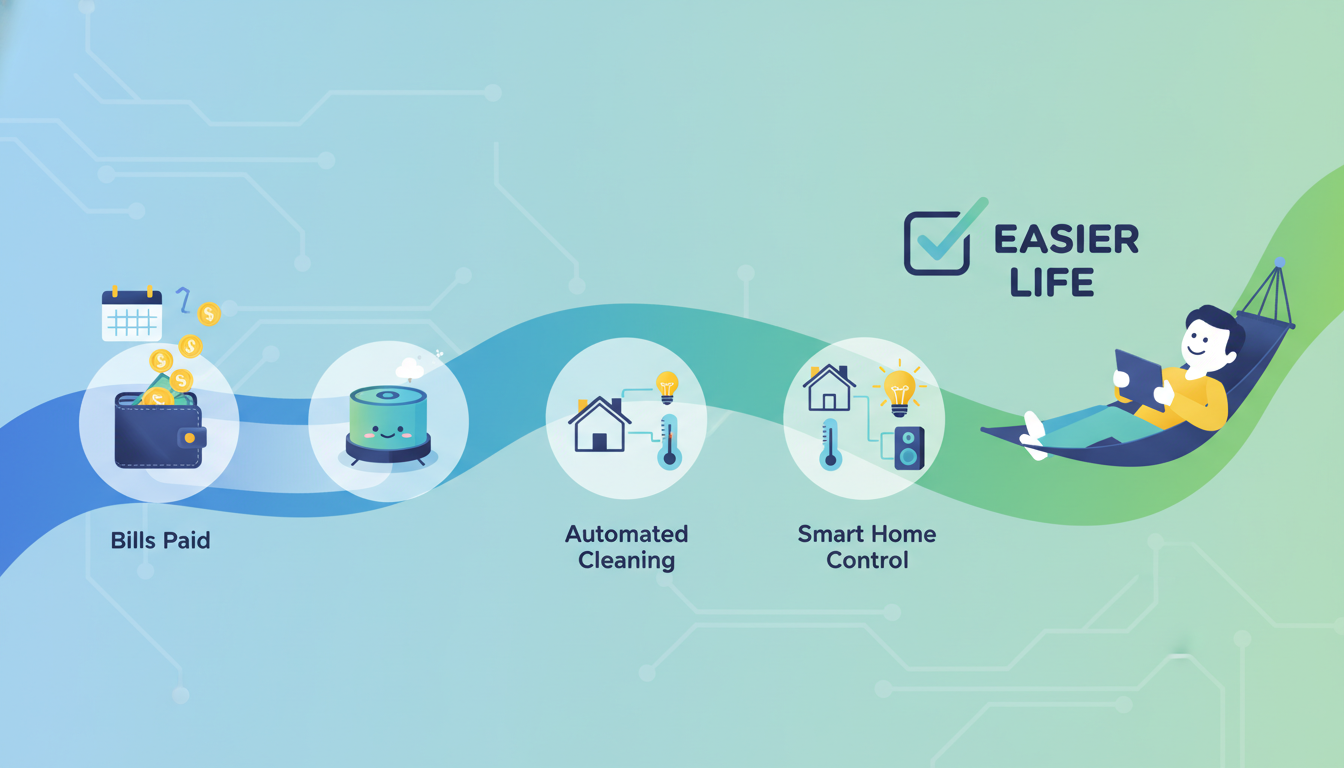
- Automate Bill Payments: Set up automatic payments for all your recurring bills (utilities, rent/mortgage, subscriptions). This eliminates the stress of remembering due dates and avoids late fees.
- Subscription Management: Use apps or services to track and manage your subscriptions, ensuring you’re not paying for things you don’t use.
- Grocery Delivery/Pickup: Automate your grocery list with recurring items or use online services for delivery or curbside pickup. This saves time and reduces impulse buys.
- Smart Home Devices: Use smart lights, thermostats, and other devices to automate environmental controls, making your home more comfortable and efficient without constant manual input.
- IFTTT/Zapier: Explore tools like IFTTT (If This Then That) or Zapier to connect different apps and automate workflows (e.g., saving email attachments to cloud storage, getting notifications for specific weather conditions).
Delegating and Outsourcing Effectively
You don’t have to do everything yourself. Learning to delegate is a skill that can dramatically lighten your load.
- Identify Tasks to Delegate: What tasks can someone else do just as well, or even better, than you? This could be cleaning, yard work, administrative tasks, or even specific work projects.
- Household Delegation: If you live with others, clearly assign chores and responsibilities. A shared calendar or chore chart can be helpful.
- Professional Outsourcing: Consider hiring a cleaner, a virtual assistant, a bookkeeper, or a dog walker if your budget allows. The time and mental energy saved often outweigh the cost.
- Asking for Help: Don’t be afraid to ask friends, family, or colleagues for assistance when you’re genuinely overwhelmed. Most people are happy to help when asked directly and clearly.
Cultivating Strong Boundaries for Energy Protection
Boundaries are the invisible fences we put around our time, energy, and mental space to protect them from depletion. Without clear boundaries, we become susceptible to the demands of others, leading to burnout and resentment. Establishing and maintaining boundaries is fundamental to an easier lifestyle.
Saying ‘No’ Gracefully and Effectively
One of the hardest but most crucial boundaries to set is saying ‘no.’ It’s not about being unhelpful or selfish; it’s about protecting your capacity to show up fully for what truly matters.
- Practice the ‘Pause’: Instead of immediately saying ‘yes,’ tell people you’ll get back to them. This gives you time to assess your capacity and the request’s alignment with your priorities.
- Offer Alternatives: If you can’t commit to a request, suggest someone else who might be able to help, or offer a smaller, more manageable contribution.
- Be Clear and Concise: A simple, ‘I appreciate you thinking of me, but I can’t take that on right now,’ is often sufficient. You don’t owe a lengthy explanation.
Time Boundaries: Protecting Your Focus
Your time is your most precious resource. Treat it as such.
- Schedule ‘Deep Work’ Blocks: Dedicate specific times in your calendar for focused, uninterrupted work on your most important tasks. Turn off notifications during these blocks.
- Limit Meeting Times: Advocate for shorter, more focused meetings. If a meeting isn’t necessary, suggest an email update instead.
- Create Buffer Time: Build in small breaks between appointments or tasks to allow for transition and unexpected delays.
Digital Boundaries: Unplugging and Disconnecting
The constant connectivity of the digital age can be a major source of overwhelm. Intentional disconnection is vital.
- Designated ‘No-Phone’ Zones: Keep your phone out of the bedroom, off the dinner table, and away during family time.
- Scheduled Digital Detoxes: Commit to periods of being completely offline – an hour before bed, a few hours on a weekend, or even a full day.
- Curate Your Feed: Unfollow accounts that trigger comparison, negativity, or anxiety. Follow those that inspire, educate, or entertain positively.
Emotional Boundaries: Protecting Your Mental Space
This involves recognizing and managing how you engage with others’ emotions and problems, ensuring you don’t absorb them as your own.
- Limit Exposure to Negativity: Reduce time spent with people who consistently drain your energy or engage in excessive complaining.
- Learn to Detach: Practice empathy without taking on the burden of solving everyone else’s problems. Offer support, but recognize what is and isn’t yours to fix.
Embracing Simplicity in Choices and Consumption
An easier lifestyle often goes hand-in-hand with simplicity. This isn’t just about owning fewer things; it’s about making fewer, more intentional choices, and consuming less information, less media, and fewer commitments.
Reducing Decision Fatigue
Every decision, no matter how small, consumes mental energy. Over the course of a day, this can lead to ‘decision fatigue,’ making it harder to make good choices later on.
- Automate Small Decisions: Create a ‘uniform’ for work, plan meals for the week, or have a default answer for common requests.
- Limit Options: When shopping, try to narrow down your choices before you even start. For example, decide on a specific type of product or a price range.
- Prioritize Decisions: Tackle your most important decisions when your energy is highest, usually earlier in the day.
Curating Your Inputs
We are constantly bombarded with information. Being selective about what you allow into your mind is crucial for mental ease.
- Mindful Media Consumption: Choose news sources carefully. Limit your exposure to sensationalized or fear-mongering content.
- Selective Reading: Don’t feel obligated to read every article, book, or email. Prioritize what genuinely interests or benefits you.
- Conscious Social Circles: Surround yourself with people who uplift and inspire you, rather than those who drain your energy or engage in constant drama.
Before committing to a new project, purchase, or social engagement, ask yourself these questions:
- Does this align with my core values and priorities?
- Do I genuinely have the time and energy for this, or am I stretching myself thin?
- Will this add true value to my life, or is it just another obligation?
- What is the opportunity cost of saying ‘yes’ to this? What will I have to say ‘no’ to?
- Is this a ‘hell yes’ or a ‘meh’? (If it’s not a ‘hell yes,’ it’s often a ‘no.’)
Prioritizing Rest, Recharge, and Self-Compassion
In our hustle-driven culture, rest is often seen as a luxury or a sign of weakness. In reality, it’s a non-negotiable component of an easier, more sustainable lifestyle. Without adequate rest and opportunities to recharge, all the streamlining and boundary-setting in the world will eventually fail.
Rest is Productive
Think of rest not as an absence of activity, but as an essential activity in itself. It’s when your body repairs, your mind processes information, and your creativity recharges.
- Quality Sleep: Prioritize 7-9 hours of quality sleep each night. Establish a consistent sleep schedule, even on weekends.
- Scheduled Breaks: Integrate short breaks throughout your workday. Step away from your screen, stretch, or take a short walk.
- True Downtime: Engage in hobbies or activities purely for enjoyment, without a goal or expectation of productivity. This could be reading, gardening, playing music, or spending time in nature.
- Vacations and Staycations: Regularly take time off to fully disconnect and recharge. Even a weekend staycation can make a significant difference.
The Myth of Constant Hustle
The idea that you must constantly be working, achieving, or optimizing to be successful is a pervasive and damaging myth. Sustainable success comes from cycles of effort and rest, not relentless pushing. Pushing through exhaustion leads to diminished returns, mistakes, and burnout.
Cultivating Self-Compassion
Building an easier lifestyle is a journey, not a destination. There will be days when you fall back into old habits, feel overwhelmed, or make less-than-ideal choices. This is where self-compassion comes in.
- Be Kind to Yourself: Treat yourself with the same understanding and patience you would offer a good friend.
- Learn from Setbacks: Instead of self-criticism, view missteps as opportunities for learning and adjustment. What can you do differently next time?
- Acknowledge Progress: Celebrate the small wins and recognize how far you’ve come, even if the journey isn’t perfect.

The Iterative Journey: Adapting Your Easier Lifestyle
Building a lifestyle that feels easier is not a one-time project; it’s an ongoing, iterative process. Life changes, circumstances evolve, and so too should your systems and strategies. What works perfectly today might need adjustment six months from now.
Regular Review and Adjustment
Just as you might review your finances or your work goals, regularly check in with your lifestyle design. Set aside time quarterly or bi-annually to assess:
- What areas of my life still feel hard or create friction?
- Which of my current systems are working well? Which are no longer serving me?
- Have my priorities or values shifted? How can my lifestyle better reflect these changes?
- Am I consistently protecting my boundaries and prioritizing rest?
This review doesn’t need to be an exhaustive overhaul. Small, incremental adjustments are often more sustainable and effective than drastic changes.
Embrace Experimentation
Think of yourself as a scientist experimenting with your own life. Try new routines, different organizational methods, or new ways of saying ‘no.’ Some experiments will work brilliantly, others might fall flat. That’s perfectly fine. The goal is to learn what truly brings ease and joy into your unique life.
Small, Consistent Steps Over Drastic Overhauls
The temptation to completely revamp everything at once can be strong, but it often leads to burnout and abandonment. Instead, focus on making small, consistent changes. Each tiny step towards simplification, automation, or boundary-setting builds momentum and reinforces your commitment to an easier life. Over time, these small shifts accumulate into profound transformations.
Conclusion
Building a lifestyle that feels easier is a profound act of self-care and intentional living. It’s about recognizing that your well-being is not a luxury, but the foundation upon which all other successes and joys are built. By understanding the sources of your overwhelm, intentionally designing your environment and routines, setting clear boundaries, and prioritizing rest, you can transform your daily experience from a struggle into a flow.
Remember, this is your journey, and there’s no single ‘right’ way to do it. Start small, be patient with yourself, and celebrate every step you take towards a life that feels lighter, more joyful, and genuinely easier. The power to design your life for ease is within you; it’s time to wield it.