
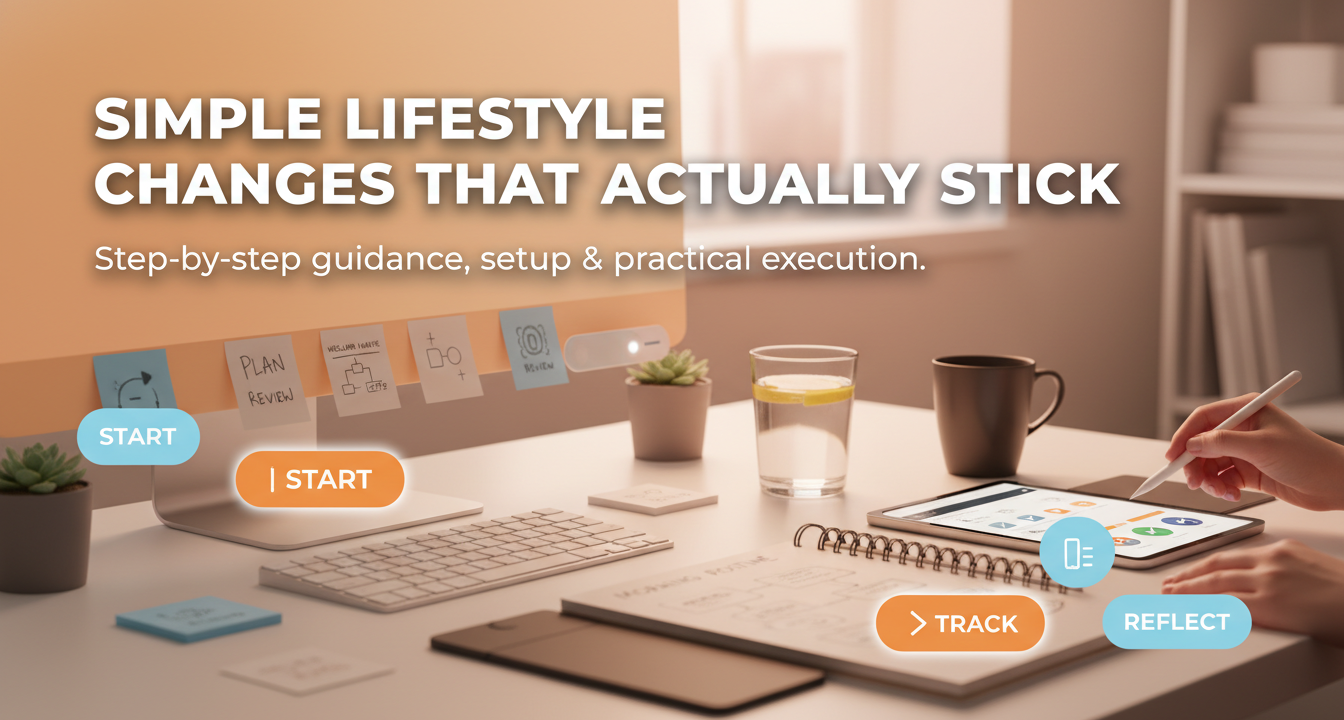
Simple Lifestyle Changes That Actually Stick
We’ve all been there: inspired by a new year, a fresh start, or a sudden burst of motivation, we declare ambitious lifestyle changes. We vow to wake up at 5 AM, run a marathon, learn a new language, and cook every meal from scratch. For a few days, maybe even a few weeks, we’re on fire. Then, slowly but surely, the flame flickers, the motivation wanes, and we find ourselves back where we started, often feeling more discouraged than before. The cycle is frustratingly common, leading many to believe they lack the willpower or discipline to make real, lasting changes.
But what if the problem isn’t your willpower, but your approach? What if the secret to making lifestyle changes stick isn’t about grand gestures and Herculean efforts, but about simplicity, consistency, and a deep understanding of human behavior? This guide is designed to help you navigate the path to sustainable change, offering practical, actionable strategies that focus on building habits that genuinely integrate into your life, rather than fighting against it. We’ll explore how to identify your true motivations, start small, optimize your environment, and cultivate resilience, ensuring your efforts lead to lasting transformation.
1. Uncover Your Deepest ‘Why’
Before you even think about what you want to change, take a moment to consider why. Surface-level reasons like ‘I want to lose weight’ or ‘I should exercise more’ often aren’t powerful enough to sustain you through the inevitable challenges. To truly make a change stick, you need to connect it to something deeper – your core values, your long-term vision for your life, or a profound sense of purpose.
For example, instead of ‘I want to eat healthier,’ dig deeper. Is it because you want to have more energy to play with your children? Do you want to reduce your risk of chronic disease to live a long, vibrant life? Do you want to feel more confident and comfortable in your own skin? These deeper motivations provide a wellspring of resilience when motivation inevitably dips.
Actionable Takeaway: Grab a journal and ask yourself ‘Why?’ five times for each desired change. Each answer should lead to a deeper, more meaningful reason. Keep asking until you hit an emotional core. Write this core ‘why’ down and place it somewhere visible as a constant reminder.
2. Start Small, Think Big: The Power of Micro-Habits
One of the biggest pitfalls in lifestyle change is trying to do too much, too soon. Our brains are wired for efficiency, and radical shifts are perceived as threats, triggering resistance. The solution? Micro-habits. These are tiny, almost ridiculously small actions that require minimal effort and time, making them easy to start and impossible to fail.
The goal isn’t to achieve a massive outcome immediately, but to build consistency and create a sense of accomplishment. Once a micro-habit is firmly established, you can gradually increase its intensity or duration. For instance, if you want to start exercising, don’t aim for an hour at the gym. Instead, commit to:
- Doing one push-up a day.
- Walking for five minutes after dinner.
- Stretching for two minutes upon waking.
These actions are so small they feel trivial, but their power lies in their ability to create a consistent routine and signal to your brain that this new behavior is safe and manageable. Over time, these small wins accumulate, building confidence and momentum that makes larger changes feel natural.
Actionable Takeaway: Identify one significant change you want to make. Now, break it down into the absolute smallest, most effortless step you can imagine. Commit to doing that one tiny step every day for a week, regardless of how you feel. Focus solely on consistency, not intensity.
3. Engineer Your Environment for Success
Your environment plays a far greater role in your habits than you might realize. We often rely on willpower to overcome environmental cues, but this is a losing battle. Instead, proactively design your surroundings to make desired behaviors easier and undesired ones harder. This is often referred to as ‘friction reduction’ and ‘friction addition.’
Think about it: if healthy snacks are readily available and visible, you’re more likely to grab them. If your running shoes are by the door, you’re more likely to go for a run. Conversely, if junk food is hidden away or requires effort to access, you’re less likely to eat it. Your environment includes not just physical objects but also the people you spend time with and the information you consume.

Practical Environmental Adjustments:
- For healthier eating: Keep fruit on the counter, pre-chop vegetables, store unhealthy snacks out of sight or don’t buy them at all.
- For exercise: Lay out your workout clothes the night before, keep weights visible, choose a gym on your commute route.
- For better sleep: Remove screens from the bedroom, invest in blackout curtains, create a calming pre-sleep routine.
- For productivity: Clear your workspace of distractions, turn off notifications, use website blockers.
Actionable Takeaway: Identify one habit you want to cultivate and one you want to break. For the desired habit, brainstorm three ways to make it easier by adjusting your physical environment. For the undesired habit, brainstorm three ways to add friction to make it harder.
4. Build a Supportive Ecosystem
You don’t have to go it alone. Humans are social creatures, and our habits are deeply influenced by those around us. Surrounding yourself with people who support your goals, share similar aspirations, or hold you accountable can dramatically increase your chances of success.
This doesn’t mean you need to cut off friends who don’t share your exact lifestyle, but it does mean being intentional about who you seek out for support and inspiration. A supportive ecosystem can take many forms:
- Accountability Partner: A friend, family member, or colleague with whom you regularly check in on your progress.
- Community: Joining a class, a club, or an online group related to your desired change (e.g., a running club, a book club, a healthy cooking group).
- Mentor: Someone who has already achieved what you’re striving for and can offer guidance and encouragement.
- Professional Support: A coach, therapist, or nutritionist who can provide expert advice and structured support.
The mere act of telling someone about your goals can create a powerful sense of commitment. Knowing that someone else is aware of your intentions can provide that extra push on days when your internal motivation is low.
Actionable Takeaway: Identify one person you trust and ask them to be your accountability partner for a specific, small goal. Schedule a weekly 5-minute check-in. Alternatively, research and join a local or online community aligned with one of your desired changes.
5. Embrace Imperfection and Learn from Setbacks
One of the most common reasons people abandon new habits is the ‘all-or-nothing’ mindset. They miss one day of their new routine, feel like a failure, and then give up entirely. This is a critical mistake. Lifestyle change is not a linear path; it’s full of twists, turns, and occasional detours. Setbacks are not failures; they are inevitable parts of the learning process.
The key is to develop resilience and self-compassion. When you miss a day, don’t beat yourself up. Acknowledge it, understand why it happened (without judgment), and then get right back on track the next day. The ‘never miss twice’ rule is a powerful mantra: if you miss one day, make sure you don’t miss the next. This prevents a single slip from spiraling into a complete abandonment of your goals.
Think of it like this: if you drop your phone, you don’t smash it into a million pieces. You pick it up and carry on. The same applies to your habits. One missed day doesn’t erase all your progress; it’s just one data point.
When a Setback Occurs, Follow These Steps:
- Acknowledge without judgment: ‘I missed my morning walk today.’
- Identify the trigger (if possible): ‘I stayed up too late watching TV.’
- Brainstorm a solution for next time: ‘I will set a reminder to turn off screens by 10 PM.’
- Recommit immediately: ‘I will do my walk tomorrow morning, no matter what.’
- Practice self-compassion: ‘It’s okay, everyone has off days. I’m still committed to my health.’
Actionable Takeaway: Mentally prepare for a setback. Decide now how you will respond when you inevitably miss a day or slip up. Write down your ‘bounce-back plan’ so you have it ready when needed.
6. Celebrate Small Wins to Build Momentum
Our brains thrive on positive reinforcement. When we achieve something, even something small, our brains release dopamine, a neurotransmitter associated with pleasure and motivation. This creates a positive feedback loop, making us more likely to repeat the behavior.
Too often, we wait for the grand finale – the target weight, the completed project, the perfect health – before allowing ourselves to feel successful. But by then, the journey might have felt like a grind. Instead, intentionally celebrate every small step forward. This isn’t about lavish rewards; it’s about acknowledging progress and reinforcing the new habit.

Ideas for Celebrating Small Wins:
- Verbal affirmation: ‘I did it! I stuck to my plan today.’
- Visual tracking: Use a habit tracker, a calendar with stickers, or a jar of marbles to visually represent your progress.
- Non-food rewards: Buy a new book, take a relaxing bath, listen to your favorite music, spend time on a hobby.
- Share your progress: Tell your accountability partner or a supportive friend about your achievement.
The key is to make the celebration immediate and directly linked to the desired behavior. This strengthens the neural pathways associated with the new habit, making it more automatic over time.
Actionable Takeaway: For your chosen micro-habit, decide on a small, immediate, non-food reward you will give yourself each time you successfully complete it for a week. This could be five minutes of guilt-free browsing, a favorite song, or a moment of quiet reflection.
7. Review, Reflect, and Adjust
Lifestyle change is an ongoing process, not a destination. What works perfectly for a few weeks might become less effective as your circumstances change or as you grow. Regular review and reflection are crucial for long-term sustainability. This allows you to identify what’s working, what’s not, and where adjustments need to be made.
Think of yourself as a scientist experimenting with your own life. Observe, collect data (even if it’s just mental notes), and then refine your approach based on the evidence. This iterative process prevents stagnation and ensures your habits remain relevant and effective.

Questions for Regular Reflection:
- What went well this week/month regarding my new habit?
- What challenges did I face?
- What did I learn about myself or the process?
- Is this habit still serving my deeper ‘why’?
- What small adjustment could I make to improve consistency or effectiveness?
- Do I need to increase the intensity or duration of this habit, or is it time to add another micro-habit?
Schedule a dedicated time each week or month for this review. It doesn’t have to be long – even 10-15 minutes can provide invaluable insights. This practice fosters self-awareness and empowers you to take ownership of your journey, rather than passively following a rigid plan.
Actionable Takeaway: Schedule a 15-minute ‘habit review’ session in your calendar for the end of this week. Use the reflection questions above to guide your thoughts and identify one small adjustment you can make for the following week.
Conclusion
Making lifestyle changes that actually stick isn’t about superhuman willpower; it’s about smart strategies, self-awareness, and a compassionate approach. By understanding your ‘why,’ starting small, optimizing your environment, building a supportive network, embracing setbacks, celebrating progress, and regularly reflecting, you can transform your aspirations into lasting realities.
Remember, consistency trumps intensity. Small, consistent efforts, repeated over time, create profound and sustainable change. Be patient with yourself, celebrate every step, and trust in the power of incremental progress. Your journey to a healthier, happier, and more fulfilling life begins with these simple, sticky steps.