

A Step-by-Step Guide to Getting Started Faster
In a world that constantly demands our attention and effort, the ability to get started quickly and efficiently is more valuable than ever. Whether you’re embarking on a new project, learning a new skill, or simply tackling your daily to-do list, the initial hurdle of ‘getting started’ can often feel like the biggest challenge. Procrastination, analysis paralysis, or simply feeling overwhelmed can keep us stuck before we even begin. But what if there was a systematic way to bypass these roadblocks and launch into action with greater speed and confidence? This guide is designed to equip you with practical strategies, clear examples, and actionable takeaways to help you master the art of getting started faster, transforming your approach to tasks and goals.
Understanding the “Why” Before the “How”
Before diving into any task, it’s crucial to establish a clear understanding of why you’re doing it. This isn’t just about motivation; it’s about clarity of purpose. When your ‘why’ is strong, it acts as a powerful compass, guiding your initial steps and sustaining you through challenges. Without a clear purpose, even the simplest tasks can feel aimless, leading to hesitation and a lack of direction.
Take a moment to reflect on the core objective. What problem are you solving? What value are you creating? What outcome are you striving for? Articulating this ‘why’ in a concise statement can provide immediate focus. For instance, instead of just ‘write a report,’ your ‘why’ might be ‘to inform stakeholders about project progress and secure necessary resources for the next phase.’ This deeper understanding transforms a mere task into a meaningful endeavor, making the initial push significantly easier.
Furthermore, understanding the ‘why’ helps in prioritizing. Not all tasks are created equal, and some contribute more directly to your overarching goals. By connecting each task to its purpose, you can quickly identify high-impact activities and allocate your initial energy where it matters most, preventing you from getting bogged down in less critical details at the outset.
Deconstructing Your Goal: Small, Manageable Chunks
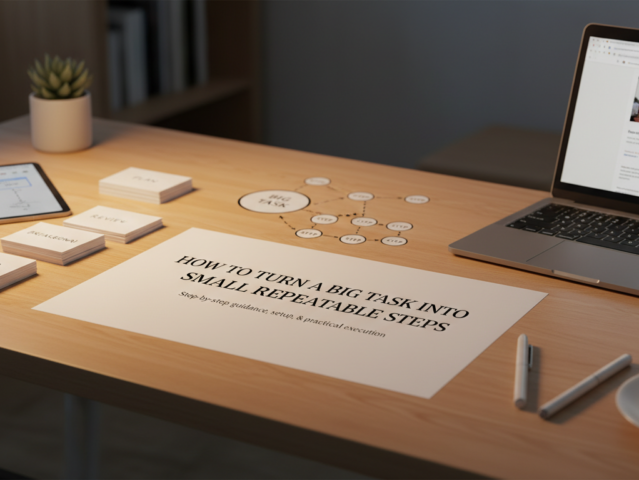
One of the most common reasons for delayed starts is the sheer perceived size of a task. A large, complex project can appear daunting, triggering feelings of overwhelm. The solution lies in deconstruction: breaking down your grand goal into smaller, more manageable, and less intimidating chunks. This strategy makes the starting point feel less like a leap and more like a series of achievable steps.
Think of it like building a house. You don’t start by building the roof; you lay the foundation, then erect the walls, and so on. Each step is a complete, albeit small, achievement. For any significant undertaking, identify the absolute smallest possible first action you can take. This ‘micro-commitment’ should be so tiny that it feels almost trivial to complete, yet it moves you forward.
- Identify the main objective: Clearly define what you want to achieve.
- Brainstorm all necessary steps: List every single action, no matter how small, required to reach the objective.
- Group related steps: Organize your brainstormed list into logical phases or sub-tasks.
- Prioritize and sequence: Determine the order in which tasks must be completed.
- Break down the first step: Find the absolute smallest, easiest action to initiate the entire process. This could be ‘open the document,’ ‘research one keyword,’ or ‘send one email.’
By focusing on these micro-commitments, you reduce the psychological barrier to entry. The goal isn’t to finish the entire project in one go, but to simply start the first small piece. This approach builds momentum and confidence, making the subsequent steps naturally easier to tackle.
The Power of a Quick Start: Overcoming Inertia
Newton’s first law of motion states that an object at rest stays at rest, and an object in motion stays in motion with the same speed and in the same direction unless acted upon by an unbalanced force. This principle applies remarkably well to human behavior and productivity. The hardest part is often overcoming the initial inertia.
A quick start isn’t about rushing; it’s about initiating movement. Even if that movement is imperfect or small, it’s far more valuable than prolonged inaction. The act of starting, no matter how minor, creates a psychological shift. It transforms you from a planner into a doer, from a thinker into an executor. This shift generates momentum, making it easier to continue working on the task.
Consider the ‘two-minute rule’: if a task takes less than two minutes to complete, do it immediately. This simple rule helps clear out small, nagging items that can accumulate and create mental clutter, freeing up cognitive space for larger projects. For bigger tasks, the goal is to simply start for two minutes. Often, once you’re engaged for those two minutes, you’ll find yourself continuing for much longer, having broken through the initial resistance.

Embrace the philosophy of ‘action over perfection’ in the initial stages. Don’t wait for the perfect plan, the perfect tools, or the perfect mood. Just begin. The act of starting provides valuable feedback, revealing what works and what doesn’t, allowing you to refine your approach as you go. The most effective way to get started faster is to simply start, even if it’s just a rough draft or a preliminary outline.
Setting Up Your Environment for Success
Your physical and digital environment plays a significant role in your ability to get started quickly and maintain focus. A cluttered, disorganized, or distracting environment can create mental friction, making it harder to concentrate and initiate tasks. Conversely, a well-organized and optimized workspace can act as a catalyst for productivity.
Before you begin a task, take a few minutes to prepare your surroundings. This isn’t procrastination; it’s strategic preparation. Clear your desk of unnecessary items, close irrelevant tabs on your computer, and silence notifications. The goal is to create a dedicated space that signals to your brain: ‘It’s time to focus.’
Here’s a checklist for optimizing your environment:
- Clear your physical workspace: Remove clutter, organize papers, and ensure essential tools are within reach.
- Optimize your digital workspace: Close unnecessary browser tabs, applications, and email clients.
- Silence notifications: Put your phone on silent or ‘do not disturb’ mode, and disable desktop notifications.
- Prepare necessary materials: Gather all documents, links, or software you’ll need for the task before you start.
- Ensure comfort: Adjust your chair, lighting, and temperature to minimize physical distractions.
- Minimize interruptions: Inform colleagues or family members if you need uninterrupted time.
By proactively setting up an environment conducive to focus, you reduce the cognitive load associated with starting. You eliminate potential distractions before they arise, allowing you to transition directly into productive work without resistance.
Leveraging Tools and Techniques for Efficiency
While the core principles of getting started faster are universal, various tools and techniques can significantly enhance your efficiency. These aren’t crutches, but accelerators that help you manage your time, prioritize tasks, and maintain momentum.
Time Management Techniques:
- The Pomodoro Technique: Work in focused 25-minute intervals, followed by a 5-minute break. This structured approach helps maintain intense focus and prevents burnout, making the start of each ‘pomodoro’ easier.
- Time Blocking: Dedicate specific blocks of time in your calendar for particular tasks. This pre-commitment reduces decision fatigue and ensures you know exactly what you should be working on at any given moment.
- Batching Similar Tasks: Group similar tasks together (e.g., answering emails, making calls, scheduling appointments). This reduces context-switching costs and allows you to get into a flow state faster for each batch.
Prioritization Methods:
- Eisenhower Matrix: Categorize tasks by urgency and importance (Do, Decide, Delegate, Delete). This helps you identify what truly needs your immediate attention, allowing you to start with the most impactful work.
- ABCDE Method: Assign a letter (A for most important, E for least) to each task. Then, tackle ‘A’ tasks first, and within ‘A’ tasks, prioritize A1, A2, etc. This clear hierarchy provides a roadmap for your starting point.

Experiment with different tools and techniques to find what resonates best with your working style. The right combination can significantly reduce the friction associated with initiating tasks, allowing you to transition into productive work with greater ease and speed.
Embracing Imperfection and Iteration
A significant barrier to getting started faster is the pursuit of perfection. The desire to produce flawless work from the outset can lead to endless planning, overthinking, and ultimately, inaction. The truth is, perfect is often the enemy of good, and more importantly, the enemy of done.
To get started faster, you must embrace imperfection, especially in the initial stages. Think of your first attempt as a ‘minimum viable product’ or a ‘rough draft.’ The goal isn’t to create a masterpiece; it’s to create something, anything, that moves you forward. This initial output serves as a foundation upon which you can build, refine, and improve.
The iterative approach encourages you to:
- Start with a ‘shitty first draft’: Give yourself permission to produce something imperfect. The act of getting ideas down, however unpolished, is a crucial first step.
- Seek early feedback: Once you have a preliminary version, share it with a trusted colleague or mentor. Early feedback can guide your improvements and prevent you from going too far down the wrong path.
- View mistakes as learning opportunities: Don’t let the fear of making errors paralyze you. Each mistake provides valuable insight, helping you refine your process and produce better results in subsequent iterations.
- Focus on progress, not perfection: Celebrate small wins and acknowledge that every step forward, no matter how small, contributes to the overall goal.
By letting go of the need for perfection in the beginning, you free yourself to simply start. The iterative process allows for continuous improvement, ensuring that your final output is polished, but only after you’ve successfully overcome the initial hurdle of getting started.
Building Sustainable Habits for Long-Term Velocity
Getting started faster isn’t just about one-off tricks; it’s about cultivating sustainable habits that make initiating tasks a natural, almost automatic, process. Habits are powerful because they reduce the need for conscious decision-making, conserving your mental energy for the task itself rather than for overcoming resistance to starting.
The key to building sustainable habits is consistency and small, repeatable actions. Focus on establishing a routine that makes starting easier. This could involve:
- The ‘trigger’ method: Pair the desired action with an existing habit. For example, ‘After I finish my morning coffee, I will spend 15 minutes on my most important task.’
- Environment design: As discussed earlier, consistently setting up your workspace before you begin reinforces the habit of preparation.
- Reward system: Acknowledge and reward yourself for successfully starting tasks, especially in the early stages of habit formation. This positive reinforcement strengthens the neural pathways associated with the new habit.
- Review and adjust: Regularly assess what’s working and what’s not. Habits aren’t set in stone; they can be tweaked and optimized over time to better suit your evolving needs.

Remember, consistency trumps intensity when it comes to habit formation. It’s better to consistently take a small, easy first step every day than to attempt a massive, overwhelming start once a week. Over time, these small, consistent starts accumulate into significant progress and a natural ability to launch into action.
Your Action Plan: Getting Started Today
You’ve absorbed the strategies, understood the principles, and now it’s time to put them into practice. The most crucial step in getting started faster is to apply what you’ve learned immediately. Don’t wait for the ‘perfect’ moment; create it by taking action right now.
Here’s a quick action plan to implement today:
- Choose one task: Pick a single task you’ve been putting off or need to start.
- Define its ‘why’: Briefly articulate the purpose and desired outcome of this task.
- Break it down: Identify the absolute smallest, easiest first step you can take.
- Prepare your environment: Clear your immediate workspace and minimize digital distractions for this one task.
- Set a timer for 15 minutes: Commit to working on that first small step for just 15 minutes.
- Just start: Begin the task, focusing only on that small first step. Don’t worry about perfection.
By following these steps, you’ll experience firsthand the power of a quick start. You’ll build momentum, gain clarity, and begin to dismantle the mental barriers that often prevent us from moving forward. This isn’t just about finishing tasks; it’s about cultivating a mindset of proactive action and continuous progress.
Conclusion
The ability to get started faster is a superpower in today’s fast-paced world. It’s not about innate talent but about adopting a strategic approach, understanding your motivations, breaking down challenges, and cultivating effective habits. By embracing imperfection, optimizing your environment, and leveraging smart techniques, you can transform your relationship with tasks and goals, moving from hesitation to decisive action.
Remember, every great journey begins with a single step. This guide has provided you with the framework to make that first step, and every subsequent step, easier and more efficient. Now, armed with these insights, it’s time to stop planning and start doing. Your faster, more productive self is waiting.